


 Location
 Login
Login
TL;DR:
- Specialty vehicles are purpose-built for specific tasks and outperform standard vehicles in their designated functions. They include categories like recreational, utility, emergency response, industrial, and mobile service units, each tailored to distinct operational needs. Cost considerations extend beyond purchase price, encompassing maintenance, insurance, training, and downtime, making a thorough needs analysis essential before buying.
A specialty vehicle is any machine engineered or modified beyond standard transportation to perform specific, mission-critical functions that mainstream vehicles cannot fulfill. The industry term you will encounter in fleet management and procurement circles is “special purpose vehicle” or “special vehicle,” though “specialty vehicle” is the widely used consumer term. These vehicles carry unique equipment, structural modifications, and operational systems that set them apart from conventional cars, trucks, and SUVs. Whether you are looking at a 400cc 4x4 UTV for trail work, an electric golf cart for property management, or a purpose-built ambulance for emergency response, the defining characteristic is the same: form follows function, not general transport.
What is a specialty vehicle and what categories exist?
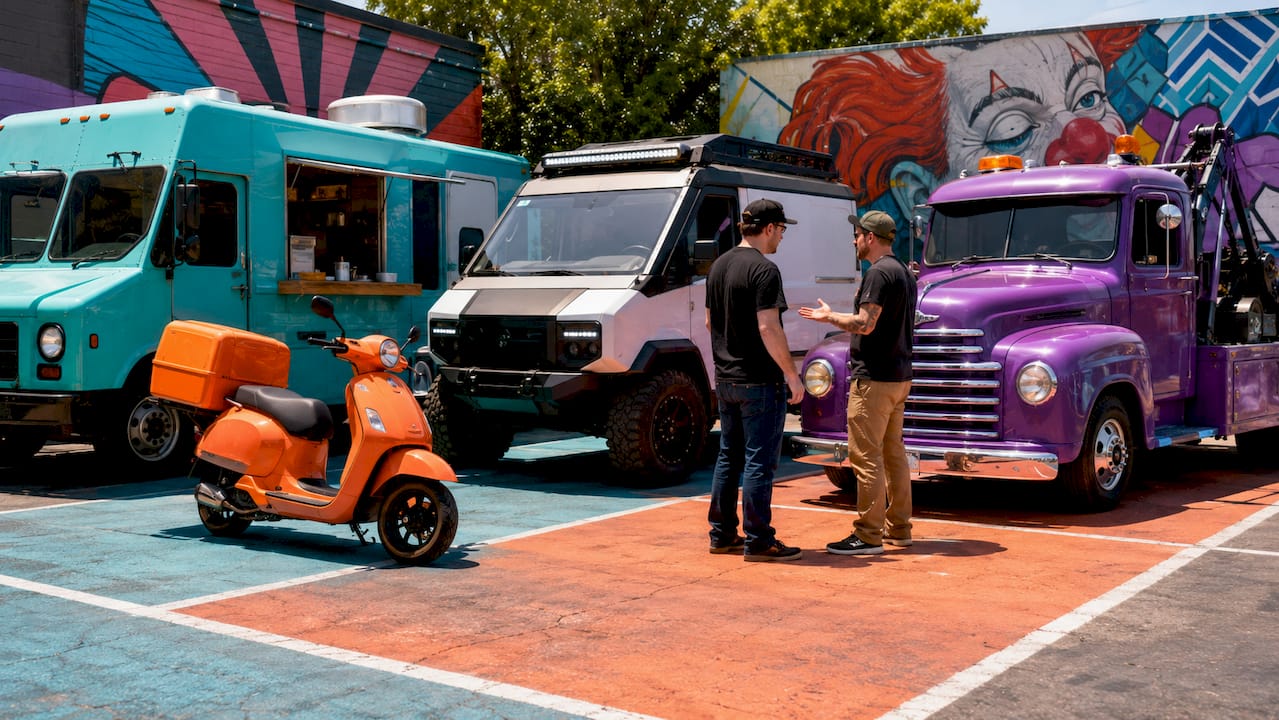
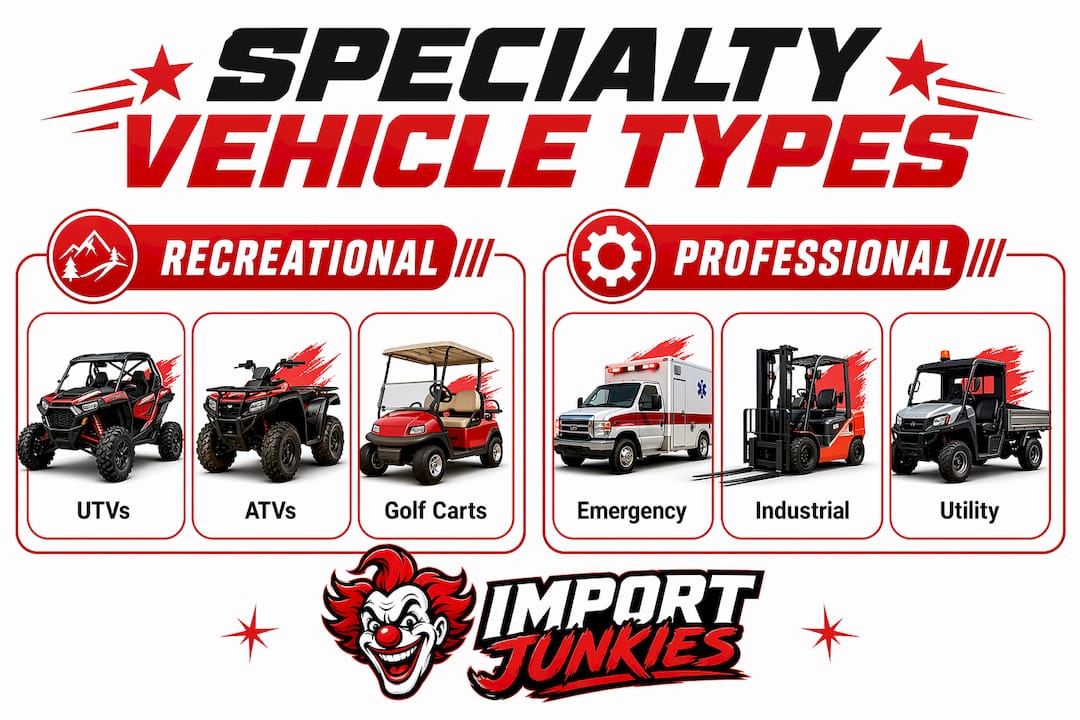
Specialty vehicles span a broader range than most buyers realize. The major categories include recreational vehicles, utility vehicles, emergency response vehicles, industrial support vehicles, and mobile service units. Each category contains distinct subcategories with equipment and structural specs tailored to their operational demands.
Here is a breakdown of the primary types:
- Recreational specialty vehicles: ATVs, UTVs, golf carts, dune buggies, snowmobiles, and off-road trikes. These are built for terrain performance, passenger capacity, and durability under repeated outdoor use rather than highway speed.
- Utility vehicles: Work-focused platforms like electric cargo trucks, dump-bed UTVs, and snow plow-equipped ATVs. The focus is payload capacity, towing, and attachment compatibility. You can read a detailed breakdown of utility vehicle types to understand which configuration fits your workload.
- Emergency response vehicles: Fire trucks, ambulances, hazmat units, and mobile command centers. These carry specialized life-safety equipment and are subject to strict regulatory standards.
- Industrial and construction support vehicles: Forklifts, aerial work platforms, and mine-spec vehicles. These operate in controlled environments with specific safety certifications.
- Mobile service units: Medical clinics, veterinary units, food trucks, and mobile labs. These convert commercial chassis into fully operational service environments.
The table below compares the most relevant categories for recreational and utility buyers:
| Category | Primary Use | Key Features | Example |
|---|---|---|---|
| Recreational UTV | Off-road trail riding, sport | 4x4 drivetrain, roll cage, suspension travel | 400cc 4x4 UTV with dump bed |
| Utility UTV | Property work, hauling, plowing | Dump bed, tow hitch, plow mount | 200cc UTV with snow plow |
| Electric golf cart | Course transport, property patrol | 48V system, quiet operation, low maintenance | 48V 4-seater Renegade Edition |
| ATV with plow | Snow removal, trail access | Auto transmission, reverse, front plow mount | 200cc ATV with snow plow |
| Electric cargo truck | Last-mile delivery, farm use | 1000W motor, cargo bed, three-wheel stability | Electric powered cargo truck |
Specialty vehicle markets include emergency response, industrial support, and recreational uses, with government funding and regulatory influence driving significant demand. For recreational and utility buyers, the practical takeaway is that the market has matured enough to offer purpose-built options at accessible price points, not just expensive custom builds.
How specialty vehicles differ from standard cars and trucks
Standard vehicles are designed for general transport: commuting, cargo hauling within normal parameters, and passenger comfort on paved roads. Specialty vehicles are designed around a specific job, terrain type, or operational environment. That distinction drives every engineering decision from the chassis up.
The differences show up in four concrete areas:
Structural design. A standard pickup truck has a frame rated for general towing and payload. A utility UTV has a frame optimized for rough terrain, attachment points for implements, and a lower center of gravity for stability on slopes. The suspension geometry, ground clearance, and tire specifications are all mission-specific.
Onboard systems. Specialty vehicles carry equipment that standard vehicles do not. An ambulance has oxygen delivery systems, power inverters, and climate-controlled storage. An electric golf cart has a 48V battery management system, regenerative braking, and a charging port designed for daily cycling. A snow plow ATV has hydraulic or manual lift systems integrated into the front frame.
Maintenance and insurance. Specialty vehicles require structured fleet management with dedicated maintenance schedules, specialized spare parts sourcing, and higher insurance costs due to their complexity. This is not a minor consideration. Parts for a purpose-built UTV or electric utility cart are not available at every auto parts store, and insurance underwriters price the risk differently than they do for a standard pickup.
Operational flexibility. A standard vehicle can be repurposed easily. A specialty vehicle is optimized for one role, which means it performs that role better but adapts less readily to other tasks. This trade-off is the core of the specialty vehicle value proposition.
| Feature | Standard vehicle | Specialty vehicle |
|---|---|---|
| Design focus | General transport | Mission-specific function |
| Terrain capability | Paved roads, light off-road | Purpose-matched terrain |
| Equipment | Factory standard | Custom or purpose-built |
| Maintenance complexity | Standard service intervals | Specialized schedules and parts |
| Insurance cost | Standard rates | Higher due to complexity |
Pro Tip: Before you commit to a specialty vehicle, list the three most demanding tasks it needs to perform. If a standard truck or SUV can handle two of those three tasks adequately, you may not need a specialty platform. If all three require specialized capability, a purpose-built vehicle will save you money in the long run.
What does it cost to buy and operate a specialty vehicle?
Cost is where many buyers get surprised. Acquisition costs for custom specialty vehicles range from $150,000 to over $500,000 for fully custom commercial builds, with full ROI typically realized within 3 to 5 years through operational efficiencies. For recreational and utility buyers, the range is far more accessible. A 48V electric golf cart runs from a few thousand dollars to $15,000 depending on configuration. A 400cc 4x4 UTV with a snow plow and dump bed sits in the $8,000 to $20,000 range at wholesale pricing.
The costs that buyers consistently underestimate fall into four categories:
- Maintenance and parts. Specialty vehicles use components that are not interchangeable with standard vehicles. Budget for longer lead times on parts and higher per-service costs. Electric vehicles reduce engine maintenance but introduce battery management and charging infrastructure costs.
- Insurance. Specialty vehicle insurance is priced on use case, not just vehicle value. A UTV used for commercial snow removal carries different liability exposure than one used for weekend trail riding. Get a use-specific quote before you finalize your purchase.
- Operator training. Some specialty vehicles require trained operators, not just licensed drivers. A utility UTV with a hydraulic dump bed and plow attachment has operational procedures that reduce injury risk when followed correctly. Factor in training time and any certification requirements in your state.
- Downtime costs. The true total cost of ownership extends well beyond the sticker price to include operational, staffing, and management expenses that buyers routinely underestimate. If your specialty vehicle is central to a revenue-generating operation, downtime has a direct dollar cost. Keep a spare parts kit for high-wear items.
On the leasing versus buying question, leasing may be preferable if your operational needs are expected to evolve within 3 to 5 years, since specialty vehicles become inflexible once customized. For recreational buyers, outright purchase almost always makes more financial sense. You use the vehicle on your terms, and resale value on well-maintained UTVs and electric carts remains reasonable.
Pro Tip: Run a formal needs analysis before you buy. Write down your terrain type, payload requirements, frequency of use, and storage conditions. Buyers who skip this step often end up with a vehicle that is either over-specified for their actual use or underpowered for the job they need done.
What trends are shaping specialty vehicles right now?
The specialty vehicle market is moving in three clear directions: electrification, modular design, and smart technology integration.
- Electrification. Electric drivetrains are the primary driver in specialty vehicle markets, with municipalities and private operators adopting electric utility trucks and ambulances to meet emissions standards and cut operational costs. For recreational buyers, electric golf carts and UTVs now offer performance that matches gas alternatives in most use cases, with lower per-mile operating costs. The shift to electric specialty vehicles aligns with both environmental policy and practical cost savings.
- Modular design. Manufacturers are building platforms that accept multiple attachment types, so one base vehicle can serve as a utility hauler, snow plow, and cargo carrier depending on the season. This reduces the total number of vehicles you need to own.
- Smart technology integration. Hybrid powertrains and integrated communication systems are enhancing efficiency and safety across the specialty vehicle spectrum. GPS tracking, telematics, and remote diagnostics are becoming standard on commercial-grade specialty vehicles and are beginning to appear on recreational platforms.
United Rentals’ strategic expansion into specialty equipment signals a deliberate focus on higher-margin, stable industries. When the largest equipment rental company in North America bets on specialty vehicles, it confirms the category’s long-term commercial viability.
The role of customization in creating functional specialty vehicles is also expanding, with aftermarket upfits making it possible to transform a base UTV or golf cart into a highly capable work platform without a full custom build.
Key takeaways
Specialty vehicles are purpose-built platforms that outperform standard vehicles in specific tasks, and selecting the right type requires matching the vehicle’s design to your actual operational demands.
| Point | Details |
|---|---|
| Specialty vehicle definition | Any vehicle engineered or modified beyond standard transport to perform a specific function. |
| Types for recreational and utility use | UTVs, ATVs, electric golf carts, cargo trucks, and snow plow platforms cover most buyer needs. |
| Cost reality | Acquisition is only part of the cost. Budget for parts, insurance, training, and downtime. |
| Leasing vs. buying | Buy if your needs are stable. Lease if your operational requirements are likely to change within five years. |
| Electrification trend | Electric drivetrains now match gas performance in most recreational and utility applications with lower running costs. |
Gary’s take on buying specialty vehicles the right way
Most buyers come to specialty vehicles from one of two directions. Either they have a specific problem they cannot solve with a standard vehicle, or they see a capable machine and start working backward to justify the purchase. The first approach almost always leads to a good outcome. The second leads to a vehicle sitting in the garage three months after delivery.
The advice I give consistently is this: do the needs analysis first, and do it honestly. Write down the terrain, the payload, the frequency of use, and the worst-case scenario the vehicle needs to handle. Then find the vehicle that meets those requirements at the lowest total cost of ownership, not the one with the most features.
Purpose-built specialty vehicles outperform RV conversions for continuous professional use because RV components fail under high-demand operations. The same principle applies at the recreational level. A purpose-built UTV with a commercial chassis will outlast a modified standard vehicle in rough terrain use, and the long-term maintenance costs will be lower. Do not buy a conversion when a purpose-built option exists at a comparable price.
One more thing worth saying directly: specialty vehicles act as strategic assets for businesses, extending reach and building visibility in ways a standard vehicle cannot. If you are a small business owner using a utility UTV for property services or a golf course operator managing a fleet of electric carts, the vehicle is not just a tool. It represents your operation to every person who sees it working. Buy accordingly.
— Gary
Find your specialty vehicle at Importjunkies
Importjunkies carries a direct-to-public selection of specialty utility and recreational vehicles at wholesale pricing, with no dealership markup.

If you need a gas-powered workhorse, the 400cc 4x4 UTV with snow plow and dump bed handles year-round utility work across rough terrain. For electric options, the 48V 4-seater Renegade Edition delivers quiet, low-maintenance performance for property management, golf facilities, and recreational use. Browse the full catalog at Importjunkies to compare specs, pricing, and configurations, or contact the team directly for guidance on matching the right vehicle to your specific needs.
FAQ
What is the specialty vehicle definition in simple terms?
A specialty vehicle is any vehicle engineered or modified beyond standard transportation to perform a specific function, such as off-road utility work, emergency response, or recreational use. The key distinction is that design decisions prioritize mission performance over general transport capability.
What are the most common types of specialty vehicles for personal use?
The most common types for personal and recreational use include UTVs, ATVs, electric golf carts, snow plow-equipped quads, and electric cargo trucks. Each is purpose-built for specific terrain, payload, or activity requirements.
Why invest in a specialty vehicle instead of a standard truck?
A specialty vehicle outperforms a standard truck in its target application because every design element serves that specific function. A 4x4 UTV with a dump bed and plow mount, for example, handles terrain and tasks that a standard pickup cannot manage safely or efficiently.
How much does a specialty vehicle cost to own?
Entry-level recreational specialty vehicles like electric golf carts and ATVs range from a few thousand dollars to around $20,000. Total ownership cost includes parts, insurance, and maintenance beyond the purchase price, which buyers consistently underestimate.
What should I check before buying a specialty vehicle?
Conduct a formal needs analysis covering terrain type, payload requirements, frequency of use, and storage conditions. Confirm parts availability and insurance costs for your specific use case before committing to a purchase.
Recommended
- Types of Recreational Vehicles: Match Your Needs – Saferwholesale || Import Junkies || Great Sports
- Utility trucks vs. golf carts: which delivers more value? – Saferwholesale || Import Junkies || Great Sports
- Must-Have Recreational Vehicles 2026: Top Picks Guide – Saferwholesale || Import Junkies || Great Sports
- Why Choose Four Wheelers: Benefits, Types, and Uses – Saferwholesale || Import Junkies || Great Sports


