


 Location
 Login
Login
TL;DR:
- Comparing e-bike models requires evaluating key features like motor type, battery capacity, and ownership convenience to ensure they fit your riding needs. Test rides and safety certifications, such as UL 2849, are essential for making an informed purchase. The right bike balances performance, comfort, and support, preventing frustration and long-term dissatisfaction.
Comparing e-bike models effectively means evaluating motor type, battery capacity, frame fit, braking systems, and ownership convenience before you spend a dollar. The industry term for this process is “electric bicycle specification evaluation,” but most buyers simply call it an e-bike model comparison. Get it right, and you end up with a bike that fits your life. Get it wrong, and you end up with money parked in the garage. This guide walks you through every factor that actually matters, including 2026 safety standards like UL 2849 certification, so you can make a confident, informed decision.
How to compare e-bike models: key features that matter
The most important features to compare when evaluating electric bikes are motor type, battery capacity, braking system, pedal-assist sensor type, and ownership convenience. Each one affects your daily experience in a different way. Skipping any of them leaves a gap in your decision.

Motor type: hub vs. mid-drive
Motor placement determines how an e-bike performs on different terrain. Hub motors suit flat terrain and budget buyers well, while mid-drive motors excel on hills by using the bike’s gears for efficiency. That efficiency difference matters most if you ride in hilly neighborhoods or carry cargo regularly. Mid-drive systems typically start at $2,000, while basic hub-motor models begin around $700, so the terrain question also shapes your budget.
Battery capacity and realistic range
A 500Wh battery delivers 30–45 miles of realistic range, while a 750Wh pack can cover 50–75 miles depending on terrain and assist level. Manufacturers often advertise best-case range figures, which assume flat roads and minimal assist. Your actual range will be lower if you ride hills, use higher assist settings, or weigh more than the test rider. Match battery size to your real commute distance, not the number on the spec sheet.
Braking systems and pedal-assist sensors
Hydraulic disc brakes outperform mechanical disc brakes in wet conditions and require less hand force to stop. For daily commuters or heavier riders, hydraulic brakes are worth the added cost. On the sensor side, torque sensors scale power to your pedaling effort, producing a smoother, more natural feel. Cadence sensors simply detect whether you are pedaling and apply a fixed power level, which feels less intuitive. Torque sensors appear most often on mid-drive and premium bikes.
Ownership convenience features
Removable batteries, hydraulic disc brakes, and UL-certified battery systems contribute more to long-term satisfaction than peak power or top speed claims. A removable battery lets you charge indoors without hauling the whole bike upstairs. UL 2849 certification confirms the battery and electrical system meet established safety standards. Check for this certification on any model you seriously consider. For a deeper look at how battery specs translate to real-world performance, the powersport battery buying guide from Banshee Battery covers capacity and chemistry in practical terms.
Pro Tip: Always check whether the battery is UL 2849 certified before purchasing. This certification is the clearest signal that the battery system has been independently tested for fire and electrical safety.
How to align e-bike features with your riding needs
The best e-bike for you depends entirely on your riding context. A bike that works perfectly for a flat urban commute will frustrate a rider tackling steep hills with groceries. Before you compare specs, define your use case clearly.
-
Identify your primary riding context. Commuting on flat city streets, climbing hills, hauling cargo, and apartment storage each demand different features. A commuter in a fifth-floor walkup needs a lightweight frame and a removable battery. A cargo hauler needs a mid-drive motor and a high-capacity battery.
-
Match motor power to your terrain and body weight. Heavier riders on hilly routes need at least 500W of continuous motor power, ideally from a mid-drive system. Lighter riders on flat ground can get by comfortably with a 250W or 350W hub motor.
-
Size the battery to your actual commute. If your round trip is 20 miles, a 400Wh battery covers it with room to spare. If you ride 40 miles daily or want a buffer for detours, step up to 500Wh or more. Read the e-bike buying guide from Importjunkies for a practical breakdown of how battery size maps to common commute lengths.
-
Factor in bike weight and storage. Most e-bikes weigh between 40 and 70 pounds. If you carry the bike up stairs or onto a train, weight becomes a primary filter, not an afterthought. Folding models solve the storage problem but often sacrifice battery size and frame rigidity.
-
Check accessory readiness and local service options. Fender mounts, rear rack compatibility, and integrated lighting matter for daily use. Equally important: confirm that a local shop can service the model you choose. Some direct-to-consumer brands use proprietary parts that most shops will not stock.
What is the best step-by-step method for comparing e-bike models?
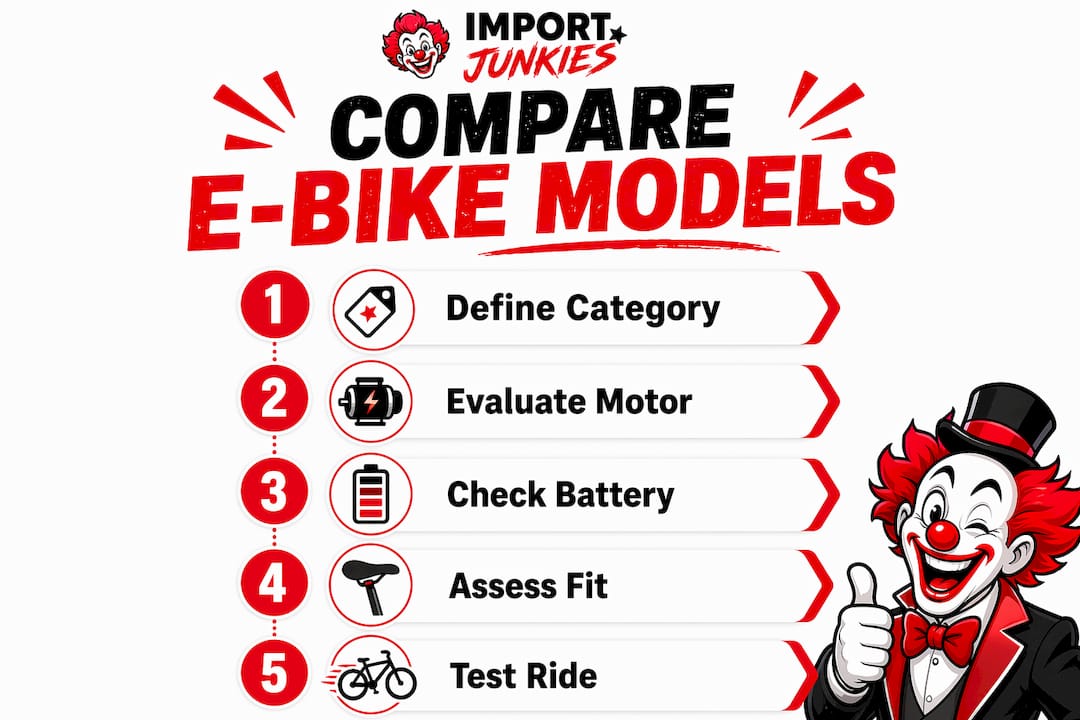
A methodical approach comparing 2–3 bikes by consistent criteria leads to better decisions than chasing the highest spec on any single dimension. The process below gives you a repeatable framework.
| Comparison step | What to evaluate |
|---|---|
| Define your category | Commuter, cargo, folding, or trail. Compare only within the same category. |
| Build a shortlist | Narrow to 2–3 models that fit your budget and riding context. |
| Create a comparison worksheet | Score each bike on fit, battery, motor type, braking, serviceability, and accessories. |
| Test ride each model | Assess comfort, handling, brake feel, and pedal-assist response in person. |
| Verify post-purchase support | Confirm warranty terms, parts availability, and local service access. |
Test rides are crucial because frame geometry, saddle comfort, and brake responsiveness cannot be judged from a spec sheet. A bike that looks perfect on paper may feel wrong the moment you sit on it. Dealers can often adjust saddle height, stem angle, and handlebar position during a test ride to improve fit. Take that opportunity seriously.
Pro Tip: Bring your real riding gear to a test ride. Shoes, a backpack, and any cargo you normally carry will change how the bike feels and how it handles. A 20-minute test ride with your actual load tells you more than an hour of reading reviews.
Avoid two common mistakes during this process. First, do not overvalue peak wattage. A 750W peak rating often reflects a brief burst, not sustained output. Continuous wattage is the more honest number. Second, do not trust advertised range without checking the test conditions. Range figures tested on flat ground at low assist levels will not match your hilly, high-assist commute.
For a parallel framework applied to another vehicle category, the step-by-step scooter comparison guide from Importjunkies uses the same systematic logic and is worth reading alongside this one.
Common pitfalls when choosing an e-bike
Most buyers make the same mistakes. Knowing them in advance saves you from a purchase you will regret within the first month.
- Buying on a single spec. A high motor wattage or a long advertised range tells you almost nothing without context. Always evaluate the full picture.
- Ignoring ownership friction. Total ownership friction, including routine battery removal, storage size, weight, and service access, predicts satisfaction better than top speed or peak power.
- Skipping the test ride. Brochure specs cannot tell you whether the saddle fits your sit bones or whether the brake levers reach your fingers comfortably.
- Overlooking service access. Many shops do not service certain direct-to-consumer e-bikes due to proprietary parts. Verify service availability before you buy, not after.
- Missing the UL 2849 certification check. This certification confirms the battery and electrical system have been independently tested. Skipping this check is a safety risk, not just a convenience issue.
“The features that reduce daily ownership hassle, such as a removable battery, hydraulic brakes, and a certified electrical system, matter more to long-term satisfaction than any single performance number on the spec sheet.”
Plan for maintenance from day one. Ask the seller how long parts typically take to arrive and whether a local shop is authorized to service the brand. A great bike with no local service support becomes a problem the first time something breaks.
Key Takeaways
Comparing e-bike models well means evaluating motor type, battery range, braking systems, and ownership convenience together, not in isolation.
| Point | Details |
|---|---|
| Motor type drives terrain fit | Hub motors suit flat rides; mid-drive motors handle hills and cargo far better. |
| Battery size should match real commute distance | A 500Wh pack covers 30–45 miles; size up if your route is longer or hilly. |
| Test rides reveal what specs cannot | Frame fit, brake feel, and pedal-assist response only show up when you ride the bike. |
| Ownership convenience predicts satisfaction | Removable batteries, hydraulic brakes, and UL 2849 certification reduce daily friction. |
| Service access is a buying criterion | Confirm local shop support and parts availability before committing to any model. |
What I’ve learned from watching buyers get this wrong
Most buyers walk into an e-bike purchase focused on the wrong things. They compare peak wattage numbers and advertised range figures, then wonder six months later why the bike sits unused. I’ve seen this pattern repeat enough times to say it plainly: the spec sheet is the least reliable predictor of satisfaction.
The buyers who end up happiest are the ones who rode the bike before they bought it, confirmed a local shop could service it, and chose a battery they could actually remove and charge in their apartment. Those are unglamorous criteria. They don’t make for exciting marketing copy. But they determine whether the bike becomes part of your daily routine or collects dust.
Safety certification is another area where buyers cut corners they shouldn’t. UL 2849 certification is not a bonus feature. It is a baseline safety check on the battery and electrical system. An uncertified battery in a poorly ventilated space is a real risk. Check for it on every model you consider.
The e-bike market in 2026 has more options than ever, which makes the comparison process more important, not less. Narrow your category first. Ride the shortlist. Verify service access. The right bike is the one that fits your life on a Tuesday morning, not just on a sunny weekend test ride.
— Gary
Electric vehicles worth considering at Importjunkies
If you are evaluating electric mobility options beyond standard e-bikes, Importjunkies carries a range of electric utility vehicles built for buyers who need more carrying capacity or a different kind of ride.

The 48V Electric Golf Cart Renegade Edition is a four-seat utility vehicle that works well for property owners, small businesses, and anyone who needs quiet electric transport across a larger area. Importjunkies sells direct to the public at wholesale pricing, with clear product pages and straightforward checkout. Browse the full catalog at importjunkies.com to see current inventory across electric bikes, golf carts, scooters, and utility vehicles.
FAQ
What is the most important feature to compare on e-bikes?
Motor type is the most critical feature because it determines how the bike performs on your specific terrain. Hub motors suit flat routes; mid-drive motors handle hills and cargo loads far better.
How do I know if an e-bike battery is safe?
Look for UL 2849 certification on the battery and electrical system. This independent safety standard confirms the components have been tested for fire and electrical hazards.
What does a 500Wh battery mean for range?
A 500Wh battery delivers 30–45 miles of realistic range under normal riding conditions. Hilly terrain, higher assist levels, and heavier riders will push that figure toward the lower end.
Why do test rides matter more than spec sheets?
Frame geometry, saddle comfort, and brake responsiveness cannot be judged on paper. A test ride reveals fit issues and handling quirks that no spec sheet will disclose.
What is the difference between torque and cadence sensors?
Torque sensors scale motor power to how hard you pedal, producing a natural ride feel. Cadence sensors detect only whether you are pedaling and apply a fixed power level, which feels less responsive and less intuitive.
Recommended
- Electric bike buying guide: find the right e-bike for your ride – Saferwholesale || Import Junkies || Great Sports
- How to compare scooters: a step-by-step guide to smart choices – Saferwholesale || Import Junkies || Great Sports
- How to Compare Golf Carts the Smart Way – Saferwholesale || Import Junkies || Great Sports
- Best Scooters for Beginners: Your 2026 Buying Guide – Saferwholesale || Import Junkies || Great Sports


