


 Location
 Login
Login
TL;DR:
- Auto lift inspections include visual, mechanical, and certified checks to ensure safety and compliance with standards. Only an ALI-certified inspector can perform the annual inspection, which evaluates hundreds of safety points beyond routine checks. Regular daily, monthly, and certified inspections prevent failures, protect shops from liability, and ensure operator safety.
Auto lift inspection is defined as a systematic process of visual, mechanical, and certified checks that verify a lift is safe to operate and compliant with ANSI/ALI ALOIM:2020 standards. Every shop lift, regardless of age or brand, requires a formal annual inspection by a qualified ALI-certified inspector. OSHA enforces these standards under the General Duty Clause, meaning undocumented inspections create liability that can result in regulatory fines and serious accidents. Knowing how to inspect an auto lift at every level, from daily visual checks to full annual audits, is the difference between a safe shop and a catastrophic failure.
What tools and prep do you need before inspecting a car lift?

Proper preparation determines the quality of any inspection. You need the right tools and documentation before you touch the lift.
The basic tool kit for a car lift safety inspection includes:
- Flashlight for illuminating dark areas under the lift carriage and inside cable channels
- Inspection mirror to view cable runs, anchor points, and hydraulic lines from angles you cannot see directly
- Torque wrench to verify anchor bolt tightness against manufacturer specifications
- Grease gun for lubricating pivot points and cable sheaves as part of routine maintenance
- Hydraulic fluid tester to check fluid condition during monthly checks
Documentation is equally critical. Pull the lift’s original owner manual, the maintenance log, and any prior inspection forms before starting. These records tell you the lift’s service history and flag recurring issues. If you are preparing for a formal annual inspection, the ALI-certified inspector will ask for this paperwork on arrival.
| Inspection Type | Who Performs It | Frequency |
|---|---|---|
| Daily visual check | Operator or mechanic | Every use |
| Monthly maintenance | Shop technician | Monthly |
| Annual safety inspection | ALI-certified inspector | Yearly |
One detail many mechanics overlook: the annual inspection is not something you perform yourself. It requires an ALI-certified inspector, and that distinction matters for both safety and OSHA compliance.
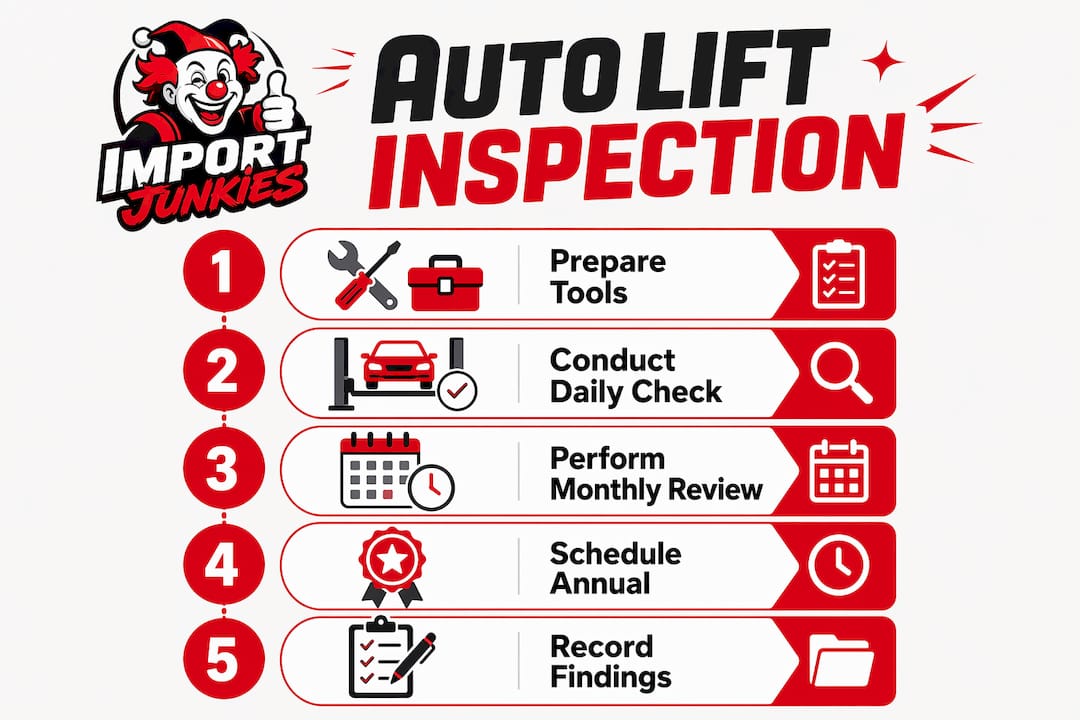
How to perform daily and monthly auto lift inspections
The most effective way to catch problems early is through consistent daily and monthly checks. These routine steps take minutes but prevent failures that cost thousands.
Daily pre-use checks
A 60-second pre-use inspection before every lift cycle is the minimum standard. Walk around the lift and check the following:
- Lift pads and arm extensions — confirm they are seated correctly and show no cracks or deformation
- Safety locks and mechanical latches — manually engage and release each lock to verify it clicks into position
- Hydraulic lines — look for wet spots, drips, or swelling along every visible hose run
- Arm alignment — confirm all four arms sit level before loading any vehicle
Abnormal noises during the initial raise are one of the earliest indicators of hydraulic or synchronization problems. Listen for grinding, clicking, or uneven motor sounds as the lift reaches full height. These sounds often appear weeks before a visible failure.
Pro Tip: Run the lift unloaded to full height and back down before placing any vehicle on it. This takes 30 seconds and reveals hydraulic hesitation, uneven arm travel, and unusual sounds before a car is at risk.
Monthly maintenance tasks
Monthly tasks go deeper than the daily visual sweep. Check hydraulic fluid levels against the manufacturer’s specified range and top off with the correct fluid type. Test each safety lock under load by raising the lift, engaging the locks, and attempting to lower the lift manually. A functioning lock holds firm. Inspect every hydraulic hose for cracking, bubbling, or chafing against metal edges. Lubricate all pivot points, cable sheaves, and equalizer pulleys per the manufacturer’s schedule.
Uneven arm movement during monthly testing signals a cable tension problem or a failing hydraulic cylinder. Do not ignore it. Address it before the next vehicle goes on the lift.
What happens during an ALI-certified annual inspection?
The annual inspection is a formal, documented process that goes far beyond what any in-house check covers. Annual inspections cover up to 120 safety points including structural components, hydraulic systems, electrical controls, and safety locks. That scope is why a certified inspector is required. No routine maintenance check replicates it.
During a certified inspection, the inspector evaluates:
- Structural integrity of the main columns, crossbeams, and base plates for cracks, weld failures, or corrosion
- Anchor bolts torqued to specification and free of movement in the floor substrate
- Mechanical safety lock engagement at every latch position across the full travel range
- Travel limit switches to confirm the lift stops at the correct upper and lower positions
- Load capacity labels verified as legible and accurate for the lift model
- Electrical controls and wiring checked for exposed conductors, damaged insulation, and proper grounding
- Hydraulic cylinder seals inspected for weeping or active leaks under load
Exceeding the rated lift capacity is a leading cause of mechanical failure, damaging cables, sheaves, and structural supports permanently. Inspectors verify load labels specifically because operators often overlook capacity limits during busy shop days. You can review the car lift weight capacity guide for a detailed breakdown of how capacity ratings work across lift types.
To prepare your lift for inspection day, tighten any loose bolts you find during your monthly checks, replace any worn pads or arm extensions, and make sure your maintenance log is current. Inspectors note deferred maintenance as a finding, and repeated findings can trigger a failed inspection.
How to inspect auto lift cables and equalizer systems
Cable inspection is one of the most specialized parts of the auto lift safety inspection process. Cables fail gradually, and the warning signs are easy to miss without knowing what to look for.
Visual signs that require immediate attention include:
- Broken wires visible on the outer strands of the cable
- Strand separation where individual wire groups pull apart from the cable body
- Kinks or sharp bends that indicate the cable was bent past its minimum radius
- Surface rust or pitting along the cable length, which signals deeper corrosion inside the strands
Cables require immediate replacement when six or more broken wires appear in one rope lay length, or when strand separation causes a 15% loss of structural strength. For heavy-use lifts, proactive replacement every 3–5 years is the standard practice regardless of visible condition.
Pro Tip: Run your gloved hand slowly along the full cable length. Broken wire ends that are not visible to the eye will catch on the glove material. This is the fishhook test, and it finds damage that a flashlight alone misses.
Internal corrosion is detectable using the birdcaging test: grip the cable firmly and twist slightly in both directions. A healthy cable returns to its original shape. A cable with internal wire breaks will show a slight outward bulge, called birdcaging, where the outer strands separate from the core.
| Cable Condition | Action Required |
|---|---|
| Surface rust, no wire breaks | Clean, lubricate, monitor monthly |
| 1–5 broken wires in one lay | Flag for replacement within 30 days |
| 6+ broken wires or strand separation | Replace immediately, take lift out of service |
| Kinks or sharp bends | Replace immediately |
Over-tightening tension nuts causes cable fatigue and uneven carriage travel. If you find yourself adjusting cable tension frequently, that pattern signals permanent cable stretch. The cable needs replacement, not more adjustments.
Common troubleshooting tips and best practices for lift maintenance
Consistent maintenance between annual inspections keeps your lift compliant and extends its service life. These practices address the most common failure points mechanics encounter.
- Track arm movement visually on every raise. If one side rises faster than the other, stop the lift immediately. Uneven travel points to a cable tension imbalance or a hydraulic cylinder issue.
- Keep a written maintenance log. Record every fluid top-off, lubrication cycle, and part replacement with the date and technician name. This log is your primary defense during an OSHA audit.
- Tag the lift after every inspection. Post the inspection date, the inspector’s name, and the next due date on the lift column where operators can see it. Documentation retention is critical for regulatory audits and insurance claims after incidents.
- Train every operator, not just lead technicians. The person who uses the lift most often is your first line of defense. A trained operator catches abnormal sounds and movement before they become failures.
Catching worn components early keeps technicians safe and avoids costly downtime. A lift that fails mid-raise does not just damage a vehicle. It puts a person under it. The inspection process exists because the consequences of skipping it are irreversible.
You can find a full breakdown of compliance obligations in the 2026 auto lift safety standards guide published by Importjunkies, which covers ANSI/ALI requirements and what shops need to document.
Key Takeaways
A safe auto lift requires daily visual checks, monthly maintenance, and a formal annual inspection by an ALI-certified inspector to meet ANSI/ALI ALOIM:2020 standards and OSHA compliance requirements.
| Point | Details |
|---|---|
| Annual inspection is mandatory | ANSI/ALI ALOIM:2020 requires a certified inspector to evaluate all lift types every year. |
| Daily checks take 60 seconds | Inspect pads, locks, hydraulic lines, and arm alignment before every use. |
| Cable replacement thresholds are specific | Replace cables immediately when six or more broken wires appear in one rope lay length. |
| Over-tightening signals cable failure | Frequent tension adjustments mean the cable has stretched permanently and needs replacement. |
| Documentation protects your shop | Inspection tags and maintenance logs are required for OSHA audits and insurance claims. |
What I’ve learned from years of watching shops skip the annual inspection
The most common mistake I see is shops treating the annual inspection as optional paperwork rather than a safety requirement. Mechanics who perform thorough daily checks sometimes assume that diligence replaces the need for a certified inspection. It does not. Qualified annual inspections differ fundamentally from in-house maintenance and are required for formal certification to stay OSHA-compliant. The 120-point scope of a certified inspection catches structural issues that no daily walk-around reveals.
The second mistake is cable neglect. Cables look fine until they do not. I have seen lifts with cables that passed a visual check fail the fishhook test on the same day. The birdcaging and fishhook tests are not optional steps for advanced technicians. They are the baseline for any honest cable assessment.
The shops that build a consistent inspection culture, daily checks logged, monthly maintenance scheduled, annual inspections booked in advance, are the ones that never have a catastrophic failure. The shops that skip steps are the ones that call for emergency service on a Friday afternoon with a car stuck in the air. Build the habit before you need it.
— Gary
Shop equipment worth knowing about at Importjunkies
Keeping your lift in top condition is one part of running a safe, productive shop. The other part is having the right support equipment around it.
Importjunkies carries a range of utility vehicles built for shop and outdoor use, including the 48V Electric Golf Cart 4 Seater Renegade Edition, which works well for moving parts, tools, and equipment across larger shop floors or outdoor lots. The inventory covers electric and gas-powered utility vehicles with competitive wholesale pricing and direct-to-public availability. If you are outfitting a shop or expanding your equipment lineup, Importjunkies offers customer service support to help you find the right fit for your operation.
FAQ
How often should you inspect an auto lift?
All automotive lifts require a formal annual inspection by an ALI-certified inspector, plus daily pre-use visual checks and monthly maintenance tasks.
What does an ALI-certified inspector check?
An ALI-certified inspector evaluates up to 120 safety points, including structural integrity, anchor bolts, hydraulic systems, electrical controls, safety locks, and load capacity labels.
When do auto lift cables need to be replaced?
Cables require immediate replacement when six or more broken wires appear in one rope lay length or when strand separation causes a 15% loss of structural strength.
Can I perform my own annual auto lift inspection?
No. The annual inspection must be performed by an ALI-certified inspector to meet ANSI/ALI ALOIM:2020 requirements and maintain OSHA compliance. In-house maintenance does not substitute for this certification.
What are the signs of a failing auto lift cable?
Look for broken wires, strand separation, kinks, and surface rust. Use the fishhook test by running a gloved hand along the cable to detect broken wire ends not visible to the eye.
Recommended
- Auto Lift Safety Standards: A 2026 Compliance Guide – Saferwholesale || Import Junkies || Great Sports
- Types of Auto Lifts: Mechanic’s Guide for 2026 – Saferwholesale || Import Junkies || Great Sports
- Auto Lift Buying Guide 2026: Choose Right, Work Safe – Saferwholesale || Import Junkies || Great Sports
- Car Lift Weight Capacity Guide for Mechanics and Shops – Saferwholesale || Import Junkies || Great Sports


