


 Location
 Login
Login
TL;DR:
- Proper assessment of operational needs and terrain ensures optimal vehicle selection and efficiency.
- Comparing vehicle types and considering long-term costs prevents costly missteps.
- Regular fleet reviews and staff testing help maintain fleet relevancy and operational safety.
Choosing the wrong vehicles for your golf course is an expensive mistake that compounds over time. A cart that struggles on hilly terrain, a utility vehicle too small for turf equipment, or a gas-powered fleet that disrupts early morning rounds can quietly erode guest satisfaction and inflate your operating budget. This guide walks you through every stage of the selection process, from assessing your actual operational needs and comparing vehicle types, to a step-by-step evaluation framework and the most common pitfalls to avoid. Whether you’re building a fleet from scratch or replacing aging equipment, the decisions you make here have real consequences.
Table of Contents
- Understanding your golf course’s vehicle needs
- Comparing key vehicle types for golf courses
- Step-by-step golf course vehicle selection process
- Common selection mistakes and how to avoid them
- Breakthrough insights from real-world golf course operations
- Find the right vehicles for your course
- Frequently asked questions
Key Takeaways
| Point | Details |
|---|---|
| Tailor to your needs | Match vehicles to specific course activities and conditions for efficiency and durability. |
| Compare by function | Evaluate main vehicle types side by side to find the best fit for your course. |
| Follow a step-by-step process | A structured approach ensures long-term value and reduces costly errors. |
| Avoid common pitfalls | Prevent overruns by considering all operational and maintenance factors. |
Understanding your golf course’s vehicle needs
Before you look at a single spec sheet, you need a clear picture of what your course actually demands from its vehicles. Not every course is the same. A flat, 18-hole suburban course has very different requirements than a hilly resort property with multiple event spaces and a full-service clubhouse. Matching vehicle type to common golf course tasks leads to operational efficiency and better guest experiences, and that starts with an honest inventory of how vehicles will actually be used day to day.
Start by listing every task your vehicles need to support:
- Guest transport: Moving players between the clubhouse, tee boxes, and fairways
- Turf maintenance: Hauling mowers, aerators, fertilizer, and other equipment across the property
- Staff transport: Getting grounds crew and event staff to different areas quickly
- Emergency response: Reaching injured guests or staff anywhere on the course
- Special events: Shuttling guests for tournaments, weddings, or corporate outings
- Cargo hauling: Moving food, beverages, and supplies from storage to service points
Next, account for your course’s physical layout. Terrain matters more than most managers initially realize. Steep grades require vehicles with stronger torque output and reliable braking. Long haul distances between holes or facilities push you toward vehicles with greater range or fuel capacity. Weather conditions in your region also affect powertrain choice, since wet or muddy terrain calls for better ground clearance and traction.
Estimate your daily use patterns carefully. Peak demand during weekend tournaments is very different from a quiet Tuesday morning. If your busiest periods require 15 vehicles running simultaneously, your fleet size and charging or fueling infrastructure must support that load without gaps.
You should also think about customizing golf carts to fit specific roles, since a standard cart can often be outfitted with cargo beds, canopies, or specialized attachments that expand its usefulness without adding another vehicle to your fleet.
Pro Tip: Talk to your maintenance crew and cart staff before finalizing any vehicle plan. They interact with the equipment daily and often identify inefficiencies, capacity gaps, or terrain problems that management-level planning misses entirely.
Understanding the benefits of electric golf carts early in this process also helps you weigh powertrain options against your course’s infrastructure, especially if you’re planning to expand charging stations or reduce fuel costs over the next few seasons.
Comparing key vehicle types for golf courses
With your needs mapped out, you can evaluate which vehicle categories actually fit your requirements. There are four main types worth considering for most golf course operations.
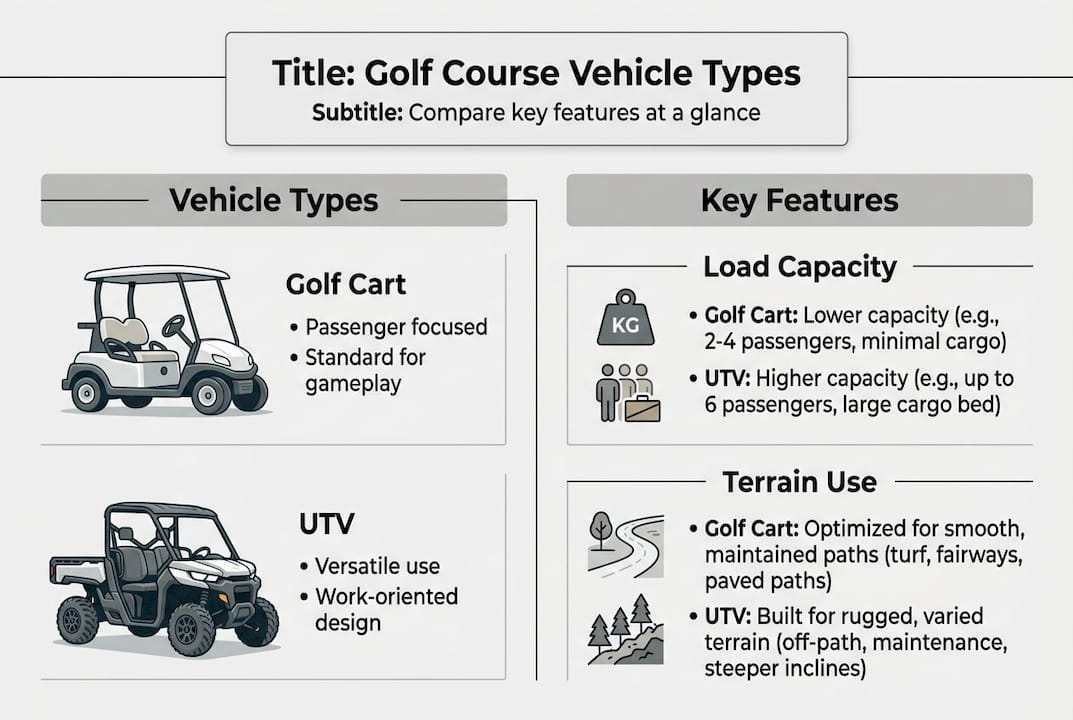
Golf carts are the backbone of guest transport on nearly every course. They’re maneuverable, quiet in electric form, and easy for guests to operate. Their limitation is cargo capacity. Standard carts carry two to four passengers and minimal gear, which makes them unsuitable for heavy maintenance work. Electric vehicles are increasingly popular for their low maintenance and quiet operation, but gas vehicles are preferred for heavy-duty hauling.
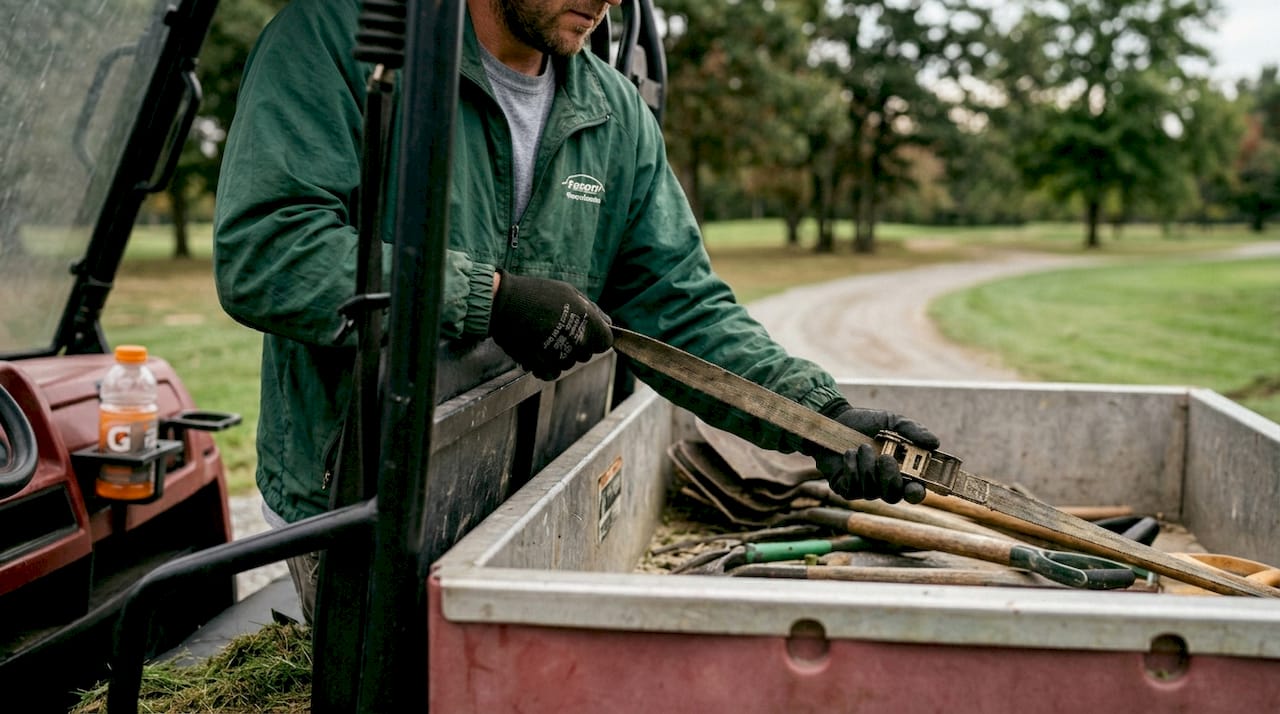
Utility Task Vehicles (UTVs), sometimes called side-by-sides, bridge the gap between a golf cart and a full-sized truck. They carry more cargo, handle rougher terrain, and can transport two to four crew members along with tools or supplies. UTVs are well-suited for maintenance teams that cover large areas of the property.
All-Terrain Vehicles (ATVs) are single or two-rider vehicles built for flexibility on uneven ground. They’re useful for emergency access, perimeter checks, or specialty tasks in areas where larger vehicles can’t easily go. They’re not ideal for regular guest transport but fill a real gap in operational coverage.
Mini trucks offer the highest cargo capacity of any option here. They’re practical for courses that move heavy loads regularly, such as bulk fertilizer, large equipment, or event supplies. The trade-off is a larger footprint and reduced maneuverability in tight spaces around the course.
| Vehicle type | Passenger capacity | Cargo capacity | Powertrain options | Best use |
|---|---|---|---|---|
| Golf cart | 2 to 4 | Low | Electric, gas | Guest transport |
| UTV | 2 to 4 | Medium to high | Electric, gas | Maintenance, staff |
| ATV | 1 to 2 | Low | Gas | Emergency, specialty |
| Mini truck | 2 | High | Gas, diesel | Heavy hauling |
Important: Always verify that your chosen vehicles meet local safety regulations for passenger transport on commercial properties. Overloading any vehicle beyond its rated capacity creates liability exposure and accelerates mechanical wear.
Step-by-step golf course vehicle selection process
Armed with a clear picture of your needs and the available options, you can move through a structured selection process. Following a structured process for equipment selection reduces costs and long-term maintenance issues, and this framework keeps you from making reactive decisions based on price alone.
- Define your needs: Use your task inventory and terrain assessment to specify minimum requirements for each vehicle role on your course.
- Set your budget: Establish both a purchase budget and an annual operating budget that covers fuel or charging, maintenance, insurance, and eventual replacement.
- Evaluate your options: Compare vehicles from multiple suppliers against your defined criteria. Use the table format below to score each option.
- Schedule test drives: Get vehicles on your actual course terrain, not just a parking lot. Real-world performance on your specific grades and surfaces is the only reliable test.
- Collect staff feedback: Have your maintenance crew and cart staff evaluate each vehicle during the demo. Their input on usability and practicality is critical.
- Finalize your purchase: Select based on total fit across all criteria, not just the lowest sticker price. Confirm warranty terms, parts availability, and supplier support before signing.
| Criteria | Golf cart | UTV | ATV | Mini truck |
|---|---|---|---|---|
| Purchase cost | Low to mid | Mid | Mid | Mid to high |
| Annual fuel/charging | Low (electric) | Mid | Mid | High |
| Maintenance frequency | Low (electric) | Mid | Mid to high | Mid |
| Cargo capacity | Low | Medium | Low | High |
| Warranty coverage | Varies | Varies | Varies | Varies |
Review the electric vs gas pros and cons carefully at this stage, since powertrain choice affects both your infrastructure investment and your ongoing operating costs significantly.
Pro Tip: Total cost of ownership (TCO) is the number that actually matters. Add up purchase price, expected fuel or charging costs over five years, estimated maintenance, and likely resale value. A vehicle that costs $2,000 more upfront but saves $500 per year in maintenance pays for itself in four years.
Common selection mistakes and how to avoid them
Even experienced operators make avoidable errors when selecting course vehicles. With your selection process in motion, it’s worth knowing where things typically go wrong.
The most frequent mistakes include:
- Underestimating required capacity: Buying carts that seat two when your course regularly runs foursomes with full bags creates constant logistical friction.
- Skipping terrain testing: A vehicle that performs well on flat ground can struggle badly on a 15-degree slope. Always test on your actual course.
- Focusing only on purchase price: Ignoring long-term energy costs or ease of maintenance is a leading cause of budget overruns for golf course operations.
- Neglecting staff training: Even well-chosen vehicles cause problems when operators aren’t trained on proper use, weight limits, and maintenance routines.
- Overlooking parts availability: A vehicle with no local service support or slow parts shipping can sit idle for weeks, disrupting operations at the worst times.
- Buying for today only: Failing to account for planned course expansions, new event programming, or changing guest demographics leads to premature fleet replacement.
Note: Vehicles without adequate safety features such as roll bars on UTVs, reliable braking on slopes, or proper lighting for early morning use can create both liability and operational hazards. Don’t trade safety features for cost savings.
Exploring customization options before finalizing your purchase can also help you avoid buying a second vehicle just to fill a specific gap, since many carts and UTVs can be outfitted with attachments that handle multiple roles.
Pro Tip: Run a structured demo day with your maintenance staff before committing to any vehicle. Assign specific tasks, note where the vehicle struggles, and ask staff to rate usability. Hidden issues almost always surface during real work, not during a sales demonstration.
Breakthrough insights from real-world golf course operations
Here’s something that doesn’t get said enough: spec sheets are not a reliable substitute for field experience. We’ve seen courses purchase vehicles with impressive ratings on paper that failed within the first season because the terrain, daily workload, or staff habits didn’t match the manufacturer’s assumptions. The numbers tell you what a vehicle can do under ideal conditions. Your course is rarely ideal.
Seasonal shifts catch a lot of operators off guard. A fleet that works perfectly through summer can fall short in fall when event volume spikes or in spring when wet turf demands different tire pressure and load management. Guest demographics shift too. Courses adding senior programming or accessible event formats often discover their existing fleet isn’t suited for those needs.
The operators who stay ahead of these issues treat fleet selection as an annual review, not a one-time decision. Rethinking electric vehicle value each season, for example, helps you catch the point where upgrading becomes more cost-effective than maintaining aging gas vehicles. Set a calendar reminder to evaluate your fleet every year, even if no immediate changes are needed. The courses that do this consistently avoid the reactive, expensive replacements that catch others off guard.
Find the right vehicles for your course
You’ve worked through the needs assessment, compared vehicle types, and mapped out a selection process that accounts for real operational demands. The next step is finding vehicles that actually deliver on those requirements.

At Import Junkies, we carry a range of vehicles built for exactly these applications. Our electric golf cart options are well-suited for guest transport and light utility work, while our ATV and UTV vehicles handle the heavier maintenance and terrain demands your crew faces. If you’re not sure which configuration fits your specific course layout and workload, reach out directly and we’ll help you match the right vehicle to your requirements.
Frequently asked questions
What are the main differences between electric and gas golf course vehicles?
Electric vehicles are ideal for quiet operation and low upkeep, while gas models excel where power output and extended range are required for heavy tasks.
How often should a golf course review and update its vehicle fleet?
At least once per year, or whenever you add new services or change your course layout, to ensure your fleet still matches your actual operational demands without unnecessary costs.
What is the most common mistake when selecting golf course vehicles?
Focusing only on purchase price and overlooking long-term operational costs is the most common mistake, and it consistently leads to budget overruns within the first few years.
What criteria should be prioritized when choosing vehicles?
Capacity, terrain compatibility, powertrain type, parts availability, and total cost of ownership should lead your evaluation criteria for any golf course vehicle purchase.
Recommended
- Best Golf Cart for Neighborhoods: What to Buy – Saferwholesale || Import Junkies || Great Sports
- Why choose electric golf carts? Benefits for golfers and courses – Saferwholesale || Import Junkies || Great Sports
- How to inspect used golf carts: a step-by-step guide – Saferwholesale || Import Junkies || Great Sports
- Customize your golf cart: complete personalization guide – Saferwholesale || Import Junkies || Great Sports


