


 Location
 Login
Login
TL;DR:
- Nearly 18,000 injuries in 2022 highlight the need for stronger golf cart safety standards.
- Implementing equipment, operator, and maintenance protocols reduces risk and liability for courses.
- Active safety culture and continuous enforcement are key to preventing preventable golf cart injuries.
Golf carts are everywhere on U.S. courses, and most operators treat them as low-risk vehicles. That assumption is costing people. Nearly 18,000 ED-treated injuries were recorded in 2022 alone, and the trend is climbing. The reality is that golf carts operate in environments with pedestrians, slopes, varying surfaces, and operators of all experience levels. Without clear, enforced safety standards, your course carries significant legal and physical risk. This guide breaks down the regulations that apply, the practical standards worth implementing, and the compliance gaps that most operators overlook until something goes wrong.
Table of Contents
- Why golf cart safety standards matter
- Golf cart classification and key regulations
- Essential safety standards for golf cart operation
- Modifications, edge risks, and continuous improvement
- A realistic approach to golf cart safety: what most standards miss
- Equip your course for safer operations
- Frequently asked questions
Key Takeaways
| Point | Details |
|---|---|
| Incidents are rising | Golf cart injuries are up nearly 24 percent annually, often involving rollovers and ejections. |
| No federal standards | Safety compliance relies on voluntary guidelines, state laws, and industry best practices. |
| Seatbelts save lives | Installing seatbelts reduces ejection injuries by up to 70 percent. |
| Proactive measures | Daily training, equipment checks, and adapting to terrain are crucial for risk reduction. |
| Customize for compliance | Vehicle modifications increase risk; always review and adapt safety standards for your unique course. |
Why golf cart safety standards matter
Golf carts may look harmless, but the injury data tells a different story. ~17,900 ED-treated injuries occurred in 2022, representing a 24% annual increase since 2016. That is not a minor statistical blip. That is a pattern that signals a systemic problem in how these vehicles are managed and operated.
Children under 15 account for a disproportionate share of incidents, often as passengers rather than operators. The injury mechanisms break down like this:
| Cause | Share of incidents |
|---|---|
| Falls or jumps from cart | 38.3% |
| Struck or run over | 16.2% |
| Collisions | 9.6% |
| Overturns | 8.9% |
Those numbers come from real incident data, and they point to one clear conclusion: most injuries are not freak accidents. They are the result of predictable, preventable situations.
“Golf cart-related injuries are often dismissed as minor, yet a significant portion result in fractures, head trauma, and in some cases, fatalities. The risk is consistently underestimated.”
Rollovers and ejections produce the most severe outcomes. When a cart tips on a slope or a passenger is thrown during a sharp turn, the consequences can be serious. The good news is that enhanced safety protocols have been shown to reduce these incidents when properly enforced.
For course operators, the liability exposure is real. A single serious injury can trigger lawsuits, insurance claims, and regulatory scrutiny. Understanding street legal golf cart requirements is one piece of the puzzle, but on-course safety standards go well beyond road use rules. The key takeaway here is that safety is not a formality. It is a direct operational responsibility.
Now that you have seen why safety matters, let’s clarify what counts as a golf cart and which regulations apply.
Golf cart classification and key regulations
One of the most common points of confusion for course managers is understanding what regulatory framework actually applies to their fleet. Golf carts are not the same as Low Speed Vehicles (LSVs), and that distinction matters legally.
| Feature | Golf cart | LSV |
|---|---|---|
| Max speed | Under 20 mph | 20 to 25 mph |
| Federal safety standards | None mandatory | FMVSS applies |
| Street use | Restricted | Permitted with equipment |
| Seatbelt requirement | Not federally required | Required |
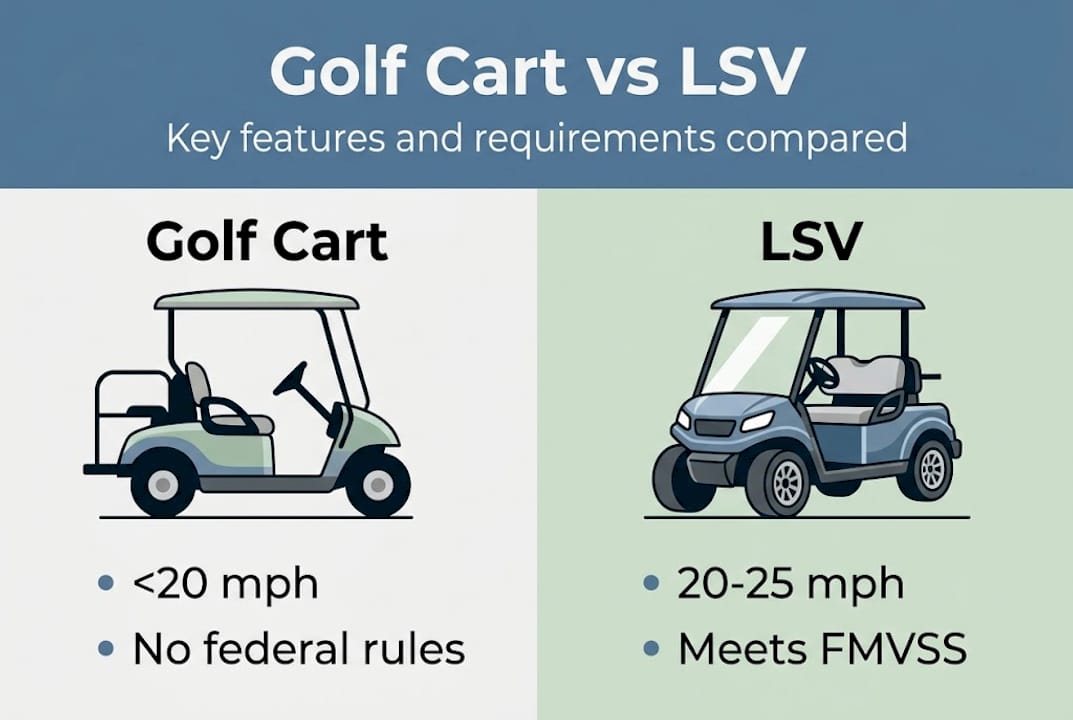
Federally, no mandatory safety standards exist for golf carts, and OSHA does not classify them as Powered Industrial Trucks when used on golf courses under ANSI Z130.1. That regulatory gap puts the burden squarely on course operators to self-regulate.
State and local laws fill some of that gap, but inconsistently. Florida Statute 316.212 is one of the more detailed examples, mandating specific safety equipment for carts used on public roads. But statutes vary widely from state to state, and many have minimal requirements for on-course use.
Here is what you should do to stay ahead of the regulatory curve:
- Review your state’s specific golf cart statutes, not just general vehicle codes.
- Check local municipal ordinances, especially if carts cross public paths or roads.
- Align your fleet with ANSI/NGCMA Z130.1 standards as a baseline.
- Consult USGA safety recommendations for operational policies that go beyond minimum legal requirements.
- Document all compliance steps in writing for liability protection.
Pro Tip: Even if your state does not require seatbelts or mirrors on course carts, installing them anyway is a low-cost move that significantly reduces your liability exposure and demonstrates due diligence.
Understanding the difference from LSV requirements also helps you make smarter purchasing decisions. If your course carts ever cross public roads, even briefly, the equipment and registration requirements shift considerably. Get clear on that boundary before an incident forces the conversation.
With regulations clarified, let’s outline the essential standards you should implement on your course.
Essential safety standards for golf cart operation
Knowing the regulatory landscape is useful, but the real work happens in your daily operating procedures. Here is what a strong safety standard looks like in practice.
Equipment requirements:
- Functional seatbelts on all carts. Seatbelts reduce ejection risk by 65 to 70%, and ejections are among the leading causes of serious injury.
- Rearview mirrors on both sides.
- Horn or audible warning device.
- Headlights and taillights for low-light or early morning use.
- Speed governors set to 15 mph or below on course.
Operator policies:
- USGA policy recommends drivers be at least 18 years old with a valid license, a maximum of two occupants per cart, and mandatory yielding to pedestrians.
- No passengers on the cart roof, hood, or hanging off the sides.
- Zero tolerance for operating under the influence of alcohol.
- All operators complete a formal safety orientation before first use.
Maintenance and inspection:
Daily inspections are not optional. Checking brakes, tires, steering, battery levels, and lights before each shift catches problems before they cause injuries. A written log of each inspection creates accountability and supports your liability defense if an incident occurs.
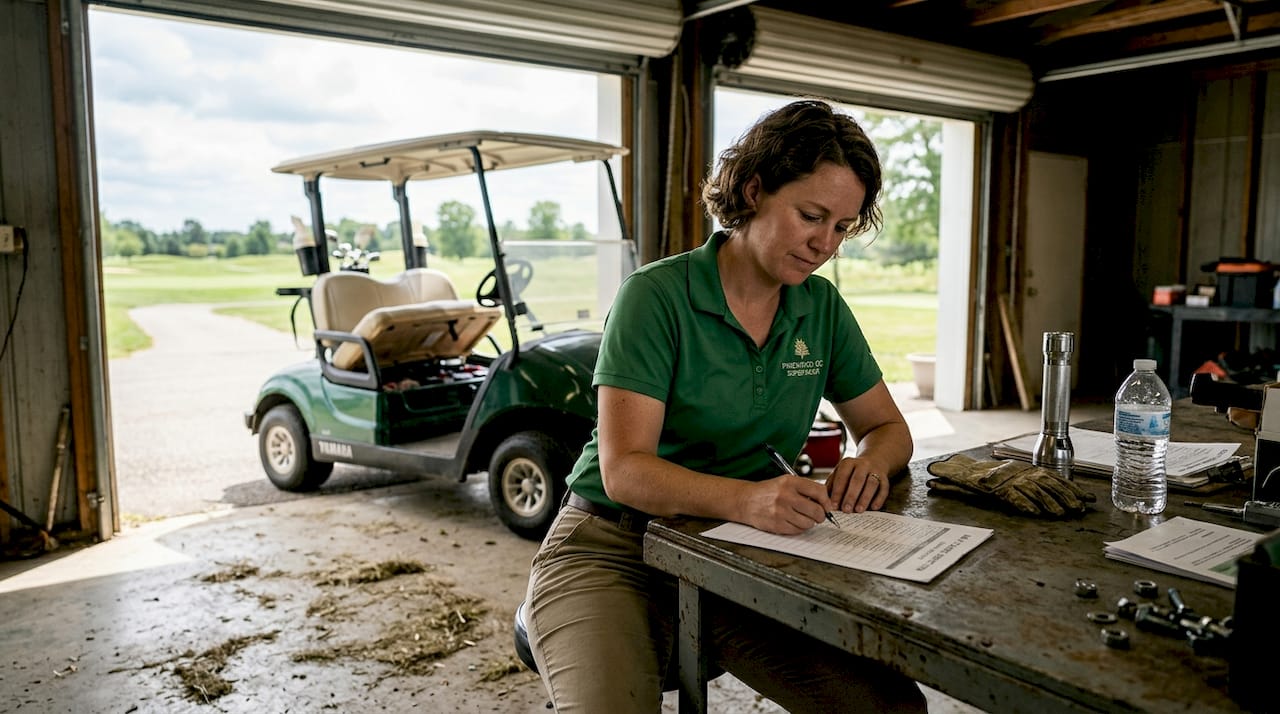
Pro Tip: Build a simple pre-use checklist that operators sign off on each morning. It takes two minutes and creates a paper trail that protects both your staff and your course.
You should also follow best operation practices for speed limits on different terrain types, passenger load limits, and procedures for reporting mechanical issues. A proactive reporting culture, where staff feel comfortable flagging problems without fear of blame, catches issues before they escalate.
Once minimum standards are in place, consider how modifications and edge cases introduce further risk.
Modifications, edge risks, and continuous improvement
Many course operators modify their carts over time, adding lift kits, larger tires, custom seats, or upgraded motors. These changes can look appealing, but they carry real consequences. Modified carts carry a 25% higher crash risk, and speeding above 15 mph is a factor in 40% of crashes. Uneven terrain accounts for 55% of rollovers, which means course layout itself is a safety variable.
Here are the modification and environmental risks worth monitoring:
- Lift kits raise the center of gravity, increasing rollover risk on slopes.
- Oversized tires can affect braking distance and steering response.
- Motor upgrades that push speed above the governor setting create serious hazard exposure.
- Wet or frost-covered turf dramatically reduces traction, especially on hills.
- Shared paths used by pedestrians and carts simultaneously require clearly marked zones and enforced speed reductions.
Alcohol is involved in 22% of nighttime incidents, and as golf carts are increasingly used beyond traditional golf settings, including resorts, communities, and events, the risk profile changes. Non-golf use often means less structured supervision and more varied terrain.
Pro Tip: If you allow any cart modifications, create a written approval process that includes a post-modification safety inspection. This keeps modifications documented and ensures no changes slip through that compromise compliance.
Continuous improvement means more than updating a policy document once a year. It means reviewing incident reports, conducting retraining after near-misses, and adjusting course signage or path layouts when patterns emerge. If the same corner keeps generating close calls, that is data. Act on it.
You can also explore resources on golf cart modifications and safety to understand which changes are worth making and which ones introduce more risk than benefit. The goal is a fleet that stays safe as it ages and as your course evolves.
These insights pave the way for a more nuanced, real-world perspective from our team.
A realistic approach to golf cart safety: what most standards miss
Here is what we have seen repeatedly: courses with detailed written safety policies still have incidents, while some courses with simpler policies have far fewer. The difference is almost always culture and daily enforcement, not the thickness of the manual.
Injuries keep climbing despite available guidelines, and that tells you something important. Awareness alone does not change behavior. What works is consistent accountability, where supervisors actually check compliance, operators know expectations are enforced, and close calls get reported and reviewed rather than quietly ignored.
Openly discussing near-misses creates buy-in. When staff see that reporting an issue leads to a fix rather than blame, they report more. That feedback loop is where real safety improvement happens. A step-by-step inspection routine is only as good as the person doing it and the culture that backs it up.
Being proactive rather than just compliant also reduces your liability. Regulators and courts look favorably on operators who go beyond minimum requirements. That posture protects you legally and operationally.
Equip your course for safer operations
Implementing strong safety standards starts with having the right equipment. Carts that come with built-in safety features, proper speed governors, and compliant configurations make it easier to meet and exceed the standards covered in this guide.

At Import Junkies, we stock compliant golf carts designed with course operators in mind, including electric models with governor controls and safety-ready builds. If your course also uses utility vehicles for maintenance or transport, our utility vehicle options give you capable, practical choices that fit your operational needs. Browse our inventory and find vehicles that make compliance straightforward from day one.
Frequently asked questions
Are seatbelts required on golf carts used on golf courses?
Federal law does not mandate seatbelts on golf carts, but seatbelts reduce ejection risk by up to 70%, making them a strongly recommended addition to any course fleet.
Who can legally operate a golf cart on a course or public road?
USGA recommends drivers be at least 18 with a valid license for course use, while Florida law sets the minimum at 14 for street use. Requirements vary significantly by state.
How often should golf carts be inspected for safety issues?
Golf carts should be inspected daily before use, following a structured checklist. Regular safety checks catch mechanical issues before they lead to injuries or liability exposure.
What equipment is required on golf carts operating on public roads?
Most states require brakes, reliable steering, safe tires, a rearview mirror, and reflectors at minimum. Florida law also specifies lights and other equipment for street use, and requirements vary by state.
Is alcohol use a major factor in golf cart accidents?
Yes. Alcohol contributes to 22% of nighttime golf cart incidents, significantly increasing crash risk and making a zero-tolerance policy essential for evening or event operations.
Recommended
- Street Legal Golf Cart Requirements Explained – Saferwholesale || Import Junkies || Great Sports
- How to inspect used golf carts: a step-by-step guide – Saferwholesale || Import Junkies || Great Sports
- Customize your golf cart: complete personalization guide – Saferwholesale || Import Junkies || Great Sports
- Why choose electric golf carts? Benefits for golfers and courses – Saferwholesale || Import Junkies || Great Sports
- Golf cart safety inspection guide: step-by-step for owners — GOLFCARTSTUFF.COM™


