


 Location
 Login
Login
TL;DR:
- Many buyers confuse utility vehicles with SUVs or ATVs, leading to costly mistakes and frustration. Utility vehicles, especially UTVs, are heavy-duty off-road machines built for rugged conditions, cargo, and passenger transport, unlike SUVs and ATVs. Properly assessing your needs, terrain, and maintenance support ensures choosing the right work or recreational UTV, with electric options offering quiet and eco-friendly advantages in specific applications.
Many buyers walk into the market looking for a “utility vehicle” and walk out with something that doesn’t actually fit their needs, often because they confused a utility vehicle with an SUV or a standard ATV. These categories are not interchangeable, and that mix-up can cost you thousands of dollars and a lot of frustration down the road. Whether you’re a small business owner looking to move materials across a property or an outdoor enthusiast who wants to haul gear through rough terrain, knowing exactly what a utility vehicle is and how to choose the right one will make all the difference.
Table of Contents
- What defines a utility vehicle?
- Main types of utility vehicles: Work vs. recreation
- Electric utility vehicles and new market trends
- How to choose the right utility vehicle for your business or adventure
- What most buyers miss about utility vehicles
- Explore top utility vehicles and find your perfect fit
- Frequently asked questions
Key Takeaways
| Point | Details |
|---|---|
| Utility vehicles serve specific tasks | UTVs are designed for off-road hauling, towing, and work—offering much more than typical passenger SUVs. |
| Work vs. recreation matters | Choosing between utility and sport UTVs depends on whether you need power and durability or fun and speed. |
| Electric models are rising | Electric UTVs are increasingly popular for farms and golf courses thanks to their quiet, eco-friendly operation. |
| Avoid budget pitfalls for business | Reliability and support are key; avoid low-cost brands if you depend on your utility vehicle for heavy tasks. |
| Research regulations and specs | Utility vehicle laws and performance vary by state and model—always check details before buying. |
What defines a utility vehicle?
The term “utility vehicle” covers a wide range of machines, but in practical terms, most people in the off-road and commercial space are referring to UTVs, which stands for Utility Terrain Vehicles. These are side-by-side machines designed to carry passengers and cargo across terrain that would stop a standard car or even many trucks in their tracks.
UTVs are built from the ground up for rugged conditions. They typically feature four-wheel drive, a roll cage, bucket or bench seating for two to six people, a rear cargo bed, and suspension systems tuned for uneven ground. That’s fundamentally different from what you get with a consumer SUV. SUVs are on-road passenger vehicles built on car or truck chassis with limited off-road capability, not the heavy-duty, terrain-specific performance of a true UTV.
It’s also worth separating UTVs from ATVs (All-Terrain Vehicles). ATVs are typically single-rider, straddle-style machines with handlebars. UTVs offer side-by-side seating, a steering wheel, and a cargo bed, which makes them far more practical for work or group recreation. Golf carts occupy another distinct category, designed primarily for flat surfaces and short distances, though electric versions are increasingly used in light utility roles.
Legal classification also varies significantly. Regulations vary by state, with many states speed-limiting UTVs under 30 mph for any road use where permitted. Some states require registration, lighting, and safety equipment before a UTV can be used on public roads at all.
Typical uses for utility vehicles include:
- Hauling feed, tools, or materials across farms and ranches
- Trail riding and group outdoor recreation
- Property maintenance such as mowing, spraying, and debris removal
- Golf course operations and resort transportation
- Construction site material movement
- Hunting access in remote terrain
Work-oriented UTVs prioritize payload and towing capacity, while sport UTVs focus on speed and suspension performance for recreation. Knowing which category fits your actual needs before you buy is the single most important step in the selection process. Understanding choosing the best utility vehicle starts with honestly evaluating how you’ll use the machine at least 80% of the time.
If you’re thinking about more unusual configurations, utility trikes offer another option worth exploring for specific work and recreation scenarios.
Main types of utility vehicles: Work vs. recreation
Knowing what utility vehicles are, let’s dig deeper into the primary types you might encounter in the market. The most fundamental split is between work-focused UTVs and sport or recreational UTVs. Both are capable machines, but they are optimized for very different demands.
Work UTVs are built to move things. High payload ratings, strong towing capacity, and durable frames are the priority. Models like the Polaris Ranger 1000 and the John Deere Gator XUV 875M represent this category well. Leading work UTV benchmarks show the Polaris Ranger 1000 delivers 61 HP with 1,000 lbs of cargo capacity and 2,500 lbs of towing, while the John Deere Gator XUV 875M matches the 1,000 lb cargo rating but pushes towing up to 4,000 lbs. The Can-Am Defender tops cargo capacity at 1,500 lbs with 3,000 lbs of towing.
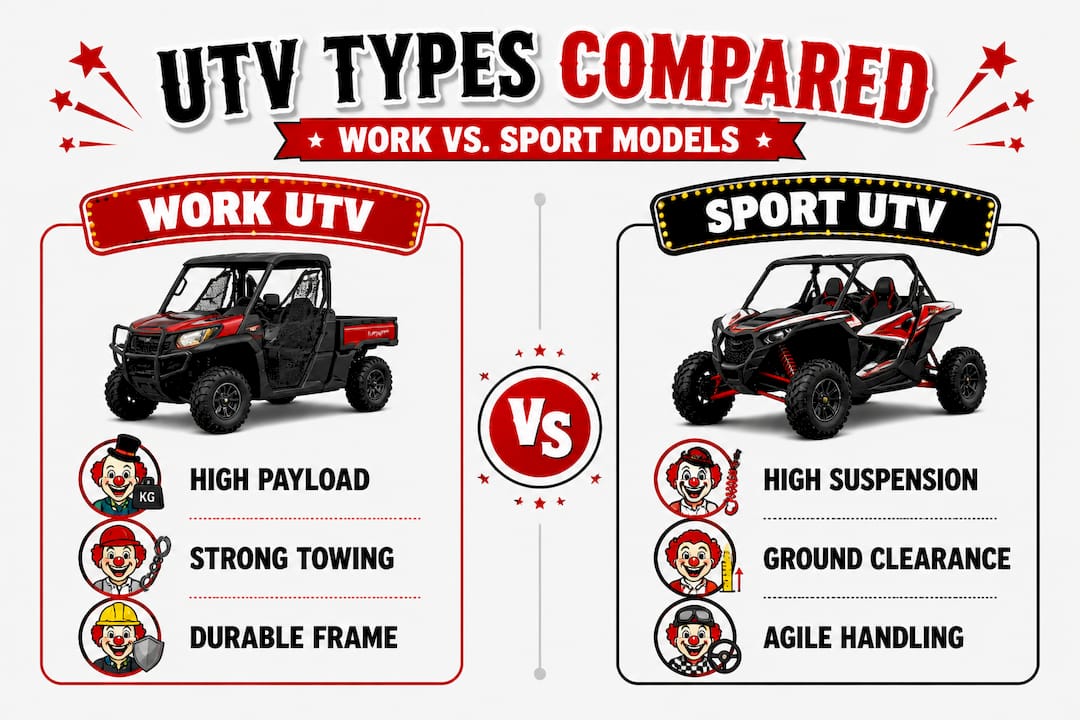
Sport UTVs, by contrast, sacrifice some payload and towing in favor of high-performance suspension, increased ground clearance, and faster acceleration. These machines are designed for trail riding, dunes, and recreational off-road use where the thrill of the ride matters as much as the work being done.
Here’s how the two categories compare side by side:
| Feature | Work UTV | Sport/Recreational UTV |
|---|---|---|
| Primary purpose | Cargo hauling, towing, farm/ranch work | Trail riding, racing, group recreation |
| Typical HP range | 40 to 100 HP | 60 to 200+ HP |
| Cargo capacity | 1,000 to 1,500 lbs | 300 to 600 lbs |
| Towing capacity | 2,500 to 4,000 lbs | 1,000 to 2,000 lbs |
| Suspension tuning | Comfort and load-bearing | Performance and aggressive terrain |
| Price range | $12,000 to $25,000+ | $10,000 to $30,000+ |
Work UTV pros and cons:
- Pro: High payload and towing ratings for real commercial use
- Pro: More durable frames built for daily workloads
- Pro: Often available with factory attachments like plows and sprayers
- Con: Less exciting to drive recreationally
- Con: Heavier overall weight affects maneuverability on tight trails
Sport UTV pros and cons:
- Pro: Superior suspension and handling on rough terrain
- Pro: Higher speeds for trail and dune riding
- Pro: Available in two to four seat configurations for groups
- Con: Lower payload limits restrict serious work applications
- Con: Higher maintenance costs on performance components
UTVs enable group trail access and gear hauling for outdoor enthusiasts, while small businesses benefit from ranch and farm utility without the cost of a full-sized truck. That said, maintenance is generally higher than with ATVs, especially on performance-oriented models.
If property maintenance is your primary use case, a dedicated UTV for property maintenance guide can help you narrow down the right work-oriented model. Before you buy anything, running through a utility vehicles checklist is a smart habit that prevents expensive oversights.
Pro Tip: For commercial use, avoid budget brands that lack a reliable parts network in the U.S. A $2,000 savings on the purchase price can quickly become a $4,000 problem when you’re waiting weeks for replacement parts during your busiest season.
Electric utility vehicles and new market trends
With many types available, electric utility vehicles are making waves, and here’s what sets them apart from gas-powered machines. The growth in electric UTVs is not just a trend driven by environmental policy. It’s a practical shift being driven by the specific needs of farms, golf courses, resorts, and property managers who need quiet, clean, and cost-efficient machines.
The UTV market is growing due to overall versatility, with electric models rising sharply for farms and golf courses where zero emissions and low noise are genuine operational priorities. On a working farm with livestock, a quiet electric UTV causes far less stress to animals than a gas engine. On a golf course, the absence of engine noise is simply non-negotiable.
Electric UTVs do have real limitations. Range is the most significant constraint. Most electric utility models offer between 30 and 60 miles per charge under load, which works well for contained properties but may not suit long trail riding sessions. Speed is another consideration, with most electric UTVs topping out around 25 to 30 mph, which is more than adequate for farm and course use but less suited for recreational riders who want higher performance.
Here is a basic comparison of electric versus gas UTV operating specs:
| Factor | Electric UTV | Gas UTV |
|---|---|---|
| Fuel/energy cost per hour | $0.50 to $1.50 | $2.00 to $5.00 |
| Noise level | Very low (near silent) | Moderate to high |
| Range per charge/tank | 30 to 60 miles | 100 to 200+ miles |
| Maintenance frequency | Low (fewer moving parts) | Moderate to high |
| Emissions | Zero | Moderate |
| Top speed | 20 to 30 mph | 40 to 80+ mph |
How to evaluate whether an electric UTV fits your needs:
- Map your property or route. Measure the total distance you cover in a typical workday to confirm the electric range is adequate.
- Assess your noise sensitivity. If you work around animals, guests, or residential areas, electric becomes a strong advantage.
- Check local regulations. State regulations vary on speed limits and road access, which may affect your decision between electric and gas.
- Calculate your operating costs. Compare fuel costs versus electricity costs over a one to three year period to see where savings actually appear.
- Evaluate charging access. Confirm you have reliable power access at the locations where the vehicle will be stored and charged overnight.
For golf course and resort operators, the case for electric vehicles for golf operations is stronger now than it has ever been, both financially and operationally.
How to choose the right utility vehicle for your business or adventure
Understanding the market, it’s time to focus on practical selection. Here’s how to ensure you get the right fit for your specific situation, whether that’s a working ranch or a weekend trail riding group.
Step-by-step buying framework:
- Define your primary use case. Is the vehicle going to carry materials, tow trailers, transport people, or handle recreational terrain? Be specific. A machine that does everything at 70% efficiency is often less valuable than one that excels at your core need.
- Set your payload and towing minimums. Look at the heaviest loads you’ll move regularly and add a 20% safety buffer. Overloading a UTV consistently breaks frames and suspensions faster than anything else.
- Evaluate terrain type. Sandy dunes, rocky trails, muddy farmland, and groomed golf courses all require different suspension and tire setups. Choose accordingly.
- Set a realistic total budget. Include the purchase price, accessories, insurance, registration fees, and a maintenance reserve for the first two years.
- Research parts availability. For commercial buyers especially, confirm that your chosen brand has dealers and parts warehouses within a reasonable distance.
- Test drive before committing. Fit and ergonomics matter more than many buyers expect. If you’re tall, if you carry passengers regularly, or if you need easy cargo bed access, these factors become real daily frustrations if ignored.
Key purchase considerations to keep on your checklist:
- Payload rating relative to your actual load needs
- Ground clearance for your specific terrain
- Seating capacity for typical passenger count
- Cab or roll cage options for safety and weather protection
- Warranty length and what it covers
- Dealer proximity for service and parts
Choosing work-focused models like the John Deere Gator or Polaris Ranger for commercial applications is strongly recommended over budget brands, where parts reliability and dealer support are often inconsistent.
Consider a real-world scenario. A rancher running 400 acres who needs to move feed daily, tow light trailers, and cover uneven ground should prioritize a work UTV with at least 1,000 lbs of cargo and 2,500 lbs of towing, with a proven parts network. A weekend trail rider who wants to take three friends through mountain terrain on a Saturday afternoon has completely different needs: a sport UTV with four seats, quality suspension, and enough speed to keep things interesting. These are not the same machine, and UTVs serve both groups well only when matched to their actual purpose.
Before finalizing any purchase, review a utility vehicles checklist and consult a broader off-road vehicle guide to make sure you haven’t overlooked a category that fits your situation better.
Pro Tip: For business buyers, after-sale support often matters more than purchase price. A dealer who answers the phone, stocks common parts, and offers fast service keeps your operation running. A dealer who disappears after the sale costs you money every day the vehicle sits idle.
What most buyers miss about utility vehicles
Most buying guides stop at specs and price. Here’s what actually separates a smart purchase from an expensive mistake.
The biggest thing buyers underestimate is the true cost of ownership over time. Many people focus entirely on the sticker price and miss the maintenance picture entirely. UTVs have multiple systems that require regular attention: engine oil, differentials, belt drives on CVT models, brake pads, suspension components, and tires. A heavily used work UTV on a farm or ranch can accumulate maintenance costs of $1,500 to $3,000 per year easily, especially in demanding environments.
Reliability means something specific in this context. It’s not just whether the vehicle runs on day one. It’s whether parts are available when something breaks six months into daily use. Budget brands in commercial applications are a consistent source of frustration because their parts are often difficult to source quickly, and dealer networks are thin. When your work depends on the vehicle, downtime is money lost.
Buying a utility vehicle based on the lowest price without researching parts availability is one of the most common and costly mistakes in this market. A machine sitting in a garage waiting for a back-ordered part delivers zero value.
Test driving is also more important than most buyers give it credit for. You need to confirm that the vehicle fits your body, that you can access the cargo bed easily, and that your passengers are comfortable on the type of terrain you’ll actually be using. These details only become obvious in a real-world test, not on a spec sheet.
Before making a final decision, walk through this utility vehicles checklist one more time with your specific use case in mind. The questions it raises may save you from a purchase you’ll regret.
Explore top utility vehicles and find your perfect fit
If you’ve worked through the sections above, you already have a much clearer picture of what you need. Now it’s time to look at real machines.

At Import Junkies, we carry a range of utility vehicles for both work and recreational buyers. If you need a machine that handles serious terrain and winter conditions, the 400cc UTV with snow plow is a standout option, combining a dump bed, four-wheel drive, and snow-clearing capability in one package. For golf course operators or property managers who need quiet, clean transportation, the 48V electric golf cart UTV offers four-seat capacity with zero emissions. You can also browse our full catalog to compare models, pricing, and features across every category we carry.
Frequently asked questions
What makes a utility vehicle different from an SUV?
Utility vehicles are purpose-built for off-road tasks and heavy-duty work, while SUVs function primarily as passenger vehicles with limited off-road capability and are built on standard car or truck platforms.
Can utility vehicles be driven on public roads?
In many states, UTVs are speed-limited under 30 mph and are only allowed on certain roads, so checking your local state regulations before operating on public roads is essential.
What are the benefits of an electric utility vehicle?
Electric UTVs deliver zero emissions and low noise, making them well-suited for farms, golf courses, and resort properties where quiet and clean operation are daily priorities.
How much cargo can a typical UTV carry?
Most utility vehicles are rated between 1,000 and 1,500 lbs of cargo depending on the model, with the Can-Am Defender topping out at 1,500 lbs and the Polaris Ranger 1000 rated at 1,000 lbs.
Are utility vehicles suitable for small businesses?
Yes, small businesses save significantly by using UTVs for ranch, farm, and property maintenance work instead of purchasing and operating full-sized commercial trucks.
Recommended
- Utility trucks vs. golf carts: which delivers more value? – Saferwholesale || Import Junkies || Great Sports
- The ultimate utility vehicles checklist for smart buyers – Saferwholesale || Import Junkies || Great Sports
- Your guide to every type of off-road vehicle – Saferwholesale || Import Junkies || Great Sports
- Purpose of Utility Trikes: Work, Recreation, Versatility – Saferwholesale || Import Junkies || Great Sports


