


 Location
 Login
Login
TL;DR:
- Commercial-grade carts feature verified load ratings, heavy-gauge steel construction, and sealed bearing casters designed for durability under daily use. They outperform residential options with thicker materials, continuous welds, and robust structural design, reducing downtime and replacement costs. Choosing the right tier and specifications based on real operational demands ensures longevity, safety, and improved productivity.
If you’ve ever searched for a commercial cart and found dozens of options all claiming to be “commercial grade,” you already know the problem. The label gets applied to everything from bargain-bin warehouse carts to genuinely field-tested utility vehicles. Understanding what makes a cart commercial grade is the difference between buying equipment that lasts years under daily stress and buying something that fails within months, costing you money in replacements and downtime. This guide breaks down load capacity, materials, caster quality, and structural design so you can evaluate any cart with confidence.
Table of Contents
- Key Takeaways
- What makes a cart commercial grade: load capacity explained
- Best materials for commercial carts
- Why caster quality defines daily performance
- Structural design and load distribution
- Commercial vs. residential carts: the real differences
- My take on cart selection as a business decision
- Find commercial grade carts at Importjunkies
- FAQ
Key Takeaways
| Point | Details |
|---|---|
| Load rating is your baseline | Always select a cart rated 20–30% above your typical maximum load to account for real-world stress. |
| Material quality drives longevity | Heavy-gauge steel and stainless steel outperform lighter metals and plastics in demanding daily use. |
| Casters determine usability | Sealed ball bearings and polyurethane wheels last significantly longer and protect floors better than standard rubber. |
| Frame design matters most | Poor load distribution and weak joints cause failure faster than substandard materials alone. |
| Commercial vs. residential is measurable | True commercial carts have verifiable specs: thicker steel, higher load ratings, and maintenance-grade caster systems. |
What makes a cart commercial grade: load capacity explained
Load capacity is the first specification most buyers look at, and it is also one of the most misunderstood. Manufacturers test under ideal, controlled conditions. Real-world field usage can reduce effective ratings by 30 to 50 percent depending on terrain, load dynamics, and how the cart is used day to day. That gap between lab rating and field performance is where a lot of buyers get burned.
Commercial carts fall into three tiers: light duty at 300 to 550 lbs, standard at 500 to 700 lbs, and heavy duty at 1,000 lbs and above. The right tier depends on your specific workflow, not just the heaviest thing you plan to move once in a while. If your team regularly loads carts near their rated maximum, you are already putting the cart in a high-stress zone.
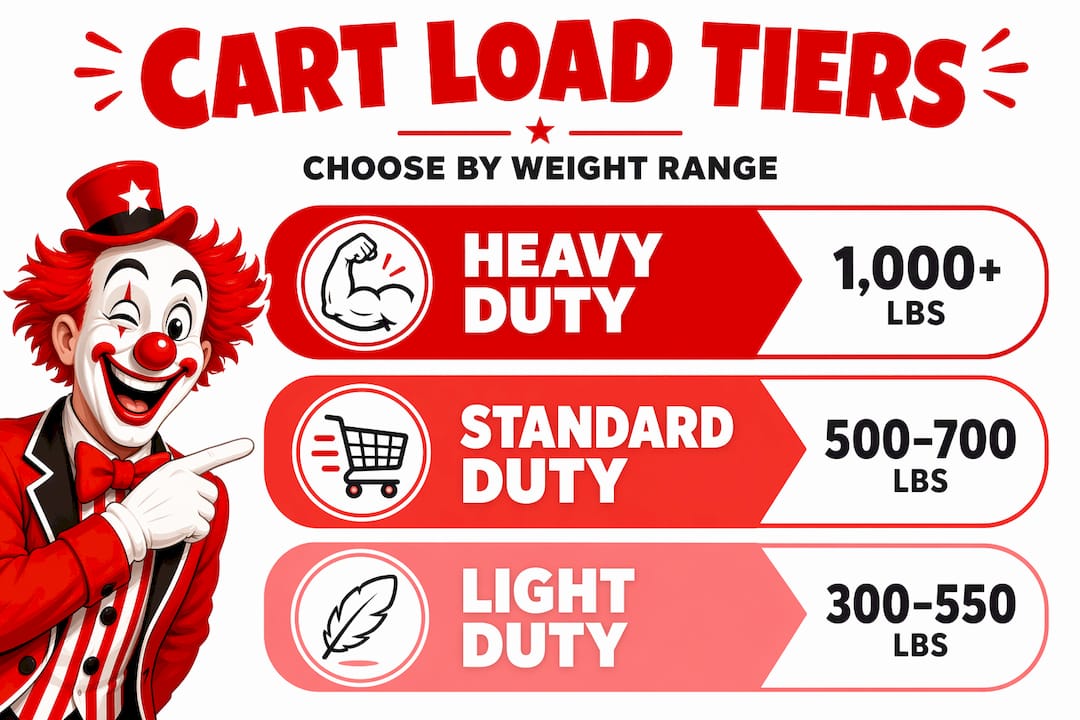
| Tier | Load Range | Typical Use Case |
|---|---|---|
| Light duty | 300–550 lbs | Retail stocking, hotel housekeeping |
| Standard | 500–700 lbs | Foodservice, small warehouses |
| Heavy duty | 1,000+ lbs | Manufacturing, automotive, logistics |
The practical rule: choose a cart rated 20 to 30 percent higher than your typical working load. If your team moves 500 lbs regularly, you want a cart rated for at least 625 to 650 lbs minimum. This safety buffer accounts for uneven loads, starting and stopping momentum, and the natural degradation of components over time. For mission-critical applications, some manufacturers even recommend finite element analysis and real-condition trials before committing to a bulk order.
Pro Tip: Ask suppliers for load test documentation, not just a spec sheet number. A verified test result tells you far more than a marketing figure.
Best materials for commercial carts
Material choice tells you more about a cart’s long-term value than almost any other single factor. The difference between commercial and residential carts often starts here, and it shows up fast under daily operational pressure.

Heavy-gauge steel and stainless steel are the two most reliable options for commercial environments. Stainless steel delivers corrosion resistance and easy cleanability, making it the standard choice in foodservice and medical settings where sanitation protocols are non-negotiable. Standard carbon steel with a quality finish works well in dry warehouse or manufacturing environments where weight and cost matter more than chemical resistance. Polymer and plastic carts have their place too. They are lighter and quieter, but they sacrifice heat resistance and load-bearing strength compared to steel.
Here is what to look for when evaluating material and construction quality:
- Steel gauge: Look for 16-gauge or lower numbers (thicker steel) in high-stress areas like shelves and frames. Consumer carts often use 20-gauge or thinner.
- Weld type: Continuous welds significantly outperform spot welds or bolted joints under the torsional and shear stress that comes from daily loaded use.
- Surface finish: Powder coating adds corrosion resistance and impact durability. Galvanization is a better choice in wet or outdoor environments.
- Joint design: Look for gusseted corners and reinforced connections at shelf brackets. These are points where cheap carts fail first.
- Plastic components: If a cart uses plastic at load-bearing points rather than just cosmetic trim, that is a red flag in any commercial setting.
The weld quality point deserves extra attention. Spot welds hold under static load but crack under repeated directional stress, which is exactly what happens every time a loaded cart hits a bump or threshold. Continuous welding bonds more surface area and distributes stress across the joint rather than concentrating it at a single point.
Pro Tip: Run a loaded cart over a small bump or door threshold before buying in bulk. Listen for frame flex and watch for any visible movement at the joints. That tells you more than a factory photo.
Why caster quality defines daily performance
The wheels and casters on a cart are the part of the system that contacts the floor and your team’s effort every single time the cart moves. Yet caster specifications are consistently underread by buyers who focus on load ratings and price alone.
Polyurethane and polymer treads offer roughly double the service life of standard rubber wheels. They also handle wet floors better, resist common chemicals, and protect finished floor surfaces from scuffing. Rubber wheels are quieter in some configurations but degrade faster under load and heat. Nylon wheels are inexpensive but unforgiving on uneven surfaces, and pneumatic wheels work well outdoors but require pressure maintenance.
Beyond the wheel material, the bearing system inside the caster determines how long the wheel will perform under load. Sealed ball bearings are what separate a commercial caster from a residential one. They prevent debris, water, and fine particles from entering the bearing race, which is what causes premature seizing in environments like warehouses, production floors, or outdoor operations.
| Caster type | Best environment | Key advantage |
|---|---|---|
| Polyurethane | Indoor hard floors | Long life, floor protection |
| Rubber | Smooth dry floors | Quiet operation |
| Pneumatic | Outdoor or uneven terrain | Shock absorption |
| Nylon | Light duty indoor | Low cost |
Wheel configuration also matters significantly. Four swivel casters work well for tight indoor spaces like kitchens or retail stockrooms. A mix of fixed rear and swivel front casters gives you better directional control on longer runs. For outdoor or mixed terrain, dual fixed plus swivel configurations provide the most stability. Swivel wheels give you maneuverability but reduce tracking; fixed wheels do the opposite. You are always managing that tradeoff, and the right answer depends on your specific floor plan and workflow.
Braking systems round out the caster picture. Any cart operating on inclines, ramps, or near dock edges needs casters with reliable foot brakes. This is not optional in most industrial or logistics environments. It is a safety specification.
Structural design and load distribution
A cart can use excellent materials and still fail quickly if the frame design is wrong. Structural failures often trace back to design flaws such as poor load distribution or weak frame connections rather than material quality alone. This is one of the most commonly overlooked factors in cart evaluation.
Consider these structural checkpoints before you commit to a purchase:
- Frame geometry: U-frame designs and four-post frames distribute load more evenly than simpler two-rail designs. Four-post frames in particular reduce torsional twist when loads are uneven or off-center.
- Shelf reinforcement: Shelves that flex visibly under load will crack welds and deform brackets over time. Look for crossbars underneath shelves on any cart rated for 400 lbs or more.
- Wheel spacing: Wider wheelbase means more stability under load. Narrow caster spacing increases tip risk, especially when loads shift during transit.
- Joint rigidity: Wobble at the shelf-to-frame connection is an early indicator of future structural failure. Check this with a loaded cart before approving a purchase.
- Vertical load path: Weight should transfer cleanly from shelf to frame to caster. Designs that route load through brackets or clip-on fittings create weak points.
| Structural feature | Poor design sign | Commercial design sign |
|---|---|---|
| Shelf support | Unsupported flat shelf | Crossbars or gusseted brackets |
| Frame connection | Bolted joints only | Welded with gussets |
| Wheel positioning | Narrow track | Wide, even spacing |
| Frame type | Flat two-rail | Four-post or U-frame |
Carts with poor load distribution show problems as shaking, wheel drift, and deformation at the joints. These are not just nuisances. They signal accelerating wear across every component. A cart that wobbles under load is distributing stress unevenly, which means some joints and wheels are working far harder than others.
Pro Tip: Before approving any bulk purchase, request a sample and load it to your expected working weight. Walk it across your actual floor surfaces, through any doorways, and up any ramps you use. That 30-minute test will save you from a costly mistake at scale.
Commercial vs. residential carts: the real differences
The difference between commercial and residential carts is not just marketing language. It is measurable across several specific specifications. Residential or light-duty carts are designed for occasional home or personal use. They are not built to survive shift after shift of real operational loading.
The total cost of ownership calculation almost always favors commercial grade when you factor in labor efficiency, reduced downtime, and replacement cycles. A cart that costs twice as much but lasts five times longer while protecting worker safety is a straightforward business decision. The challenge is that the initial price difference can feel significant, especially when buying multiple units.
Here is where the real differences show up:
- Steel thickness: Commercial carts use 14 to 18-gauge steel. Residential options often use 20-gauge or lighter, which deforms under repeated heavy loading.
- Load ratings: Commercial carts are load-tested to verified specifications. Many consumer-grade carts carry optimistic ratings that assume perfect conditions.
- Caster systems: Commercial casters use sealed bearings and better tread compounds. Residential casters use open bearings with basic rubber wheels that wear and flatten under sustained load.
- Weld quality: Commercial construction uses continuous welds at structural joints. Consumer carts rely on spot welds or mechanical fasteners that loosen over time.
- Finish durability: Commercial powder coating is applied thicker and cured longer. Consumer finishes chip and corrode faster in any working environment.
High-quality casters and balanced frame design also reduce worker fatigue and accident risk, which adds measurable productivity value over time. That is a benefit you simply do not get from residential-grade equipment, regardless of what the label says.
My take on cart selection as a business decision
I’ve seen this play out dozens of times. A buyer focuses on the price per unit, orders 20 carts to keep the budget tight, and within eight months half of them have bent shelves, wobbly casters, and cracked welds. Then they replace them. The second purchase, once you add the labor disruption and the replacement cost, ends up costing significantly more than buying commercial grade the first time.
What I’ve learned from watching operations teams work with both ends of the quality spectrum is this: the people actually using the carts notice the difference immediately. A cart that tracks straight, handles its rated load without flexing, and doesn’t squeal or shimmy reduces physical effort per shift. Ergonomic handles and balanced cart design reduce cumulative strain injuries, which carry their own cost in your business.
My practical advice is to treat the cart specification conversation the same way you treat any equipment purchase. Request load documentation. Ask how the product is tested. Push for field references or case studies from similar operations. A supplier who can answer those questions without hesitation is a supplier worth buying from. One who deflects to catalog photos is not.
The right cart for your operation is the one that matches your actual daily load, your floor environment, your team’s workflow, and your replacement tolerance. Buy to that spec, not to the lowest price point on the page.
— Gary
Find commercial grade carts at Importjunkies
If you’ve read this far, you know exactly what to look for. Now the question is where to find it. Importjunkies carries utility vehicles and heavy-duty carts built to specifications that hold up in real working conditions, not just on a spec sheet.

The 650S Mighty Hauler is a strong example of commercial-grade load handling built for serious use. For operations needing heavier capacity, the electric cart with 1,100 lb capacity handles demanding warehouse and logistics environments. Importjunkies also offers the GSI GVX Limo gas golf cart, a six-seater utility vehicle suited for larger commercial properties. All products include transparent pricing, shipping details, and direct customer support so you can make the purchase decision with full information. Browse the full lineup at importjunkies.com or reach out to the team with your operational specs.
FAQ
What makes a cart truly commercial grade?
A commercial grade cart has verified load ratings, heavy-gauge steel construction with continuous welds, sealed-bearing casters, and a frame designed to distribute load evenly under repeated daily use. These specs must be documented, not just claimed.
How do I check if a cart’s load rating is reliable?
Ask the supplier for load test documentation and confirm whether the rating reflects ideal or real-world conditions. Manufacturers’ rated loads are often measured under ideal lab conditions, which can overstate real-world capacity by 30 to 50 percent.
What caster type is best for commercial indoor use?
Polyurethane casters with sealed ball bearings are the standard choice for commercial indoor environments. They offer roughly double the service life of standard rubber wheels and protect finished floor surfaces from damage.
Is stainless steel always better for commercial carts?
Stainless steel is the best choice for food service, medical, and wet environments because of its corrosion resistance and cleanability. For dry warehouses or manufacturing, heavy-gauge carbon steel with powder coating offers comparable strength at lower cost.
How is a commercial cart different from a residential one?
The key differences are measurable: commercial carts use thicker steel, higher verified load ratings, sealed caster systems, and continuous welds at structural joints. Residential carts use lighter materials and are not built for repeated heavy loading across daily shifts.
Recommended
- Golf cart features: a complete buyer’s guide for 2026 – Saferwholesale || Import Junkies || Great Sports
- Utility trucks vs. golf carts: which delivers more value? – Saferwholesale || Import Junkies || Great Sports
- How to inspect used golf carts: a step-by-step guide – Saferwholesale || Import Junkies || Great Sports
- Best golf carts for business: Boost efficiency and utility – Saferwholesale || Import Junkies || Great Sports


