


 Location
 Login
Login
TL;DR:
- Choosing a suitable outdoor scooter requires prioritizing stability, wheel configuration, and suspension over mere lightweight design.
- Larger battery range, powerful motors, pneumatic tires, and adequate ground clearance are essential for handling diverse terrains confidently.
Not all scooters are built alike, and that gap becomes obvious the moment you take a cheap model off the sidewalk and onto gravel, grass, or a sloped path. Understanding what makes a good outdoor scooter comes down to far more than price or looks. The right combination of motor power, tire type, wheel configuration, and battery range determines whether your scooter handles real terrain confidently or leaves you stranded halfway through your ride. This guide covers every critical feature, compares design options side by side, and gives you the practical knowledge to choose a model that fits your terrain and lifestyle.
Table of Contents
- Key features defining a good outdoor scooter
- How wheel configuration and suspension affect stability and terrain handling
- Battery range, weight, and portability considerations for outdoor scooters
- Tires, ground clearance, and suspension: optimizing for rugged outdoor terrain
- Common mistakes and expert tips for choosing the right outdoor scooter
- Why prioritizing stability over portability transforms your outdoor scooter experience
- Explore top-quality mobility scooters for outdoor adventures
- Frequently asked questions
Key Takeaways
| Point | Details |
|---|---|
| Stability is crucial | A wider wheelbase and 4-wheel design improve balance on uneven terrain far more than lightweight alone. |
| Battery range varies | Expect 10 to 25 miles per charge, but real-world range is often 20-40% less than advertised. |
| Tires and suspension matter | Pneumatic tires and full suspension systems greatly enhance comfort and control outdoors. |
| Portability trade-offs | Heavier scooters with better features offer improved performance but may be harder to transport. |
| Match scooter to terrain | Choose features based on your typical outdoor environment and daily travel needs for best results. |
Key features defining a good outdoor scooter
The features of outdoor scooters that matter most are the ones you feel immediately when conditions get imperfect. Smooth pavement forgives a lot. Dirt trails, wet sidewalks, and uneven paths do not.
Here are the core features that separate a capable outdoor scooter from one that belongs indoors:
- Battery range. Most outdoor scooters offer 10 to 25 miles per charge, with lightweight models sitting closer to 12 miles. That range works for errands and short recreational rides, but longer trails require a scooter with a larger battery pack.
- Motor power. For hills or packed gravel, you need a motor with enough torque to push through resistance. Underpowered motors bog down on inclines, which is not just frustrating but a safety concern.
- Pneumatic tires. Air-filled tires absorb shocks that solid tires transmit directly to the rider. On bumpy terrain, that difference is significant. Pneumatic tires also provide better grip on loose surfaces like gravel or damp grass.
- Suspension systems. Front forks with suspension, rear shock absorbers, or both, smooth out repeated impacts on uneven ground. Without suspension, even a good motor and tires feel punishing over distance.
- Weight and portability trade-offs. Lighter scooters are easier to transport and store. However, very light models often sacrifice suspension depth and tire size, both of which matter outdoors. This trade-off is worth understanding before you buy.
For context on which scooter type matches your specific riding scenario, the scooter types guide at Import Junkies breaks down the options clearly.
How wheel configuration and suspension affect stability and terrain handling
Understanding key features sets the stage to explore how wheel design and suspension directly impact your scooter’s outdoor performance.
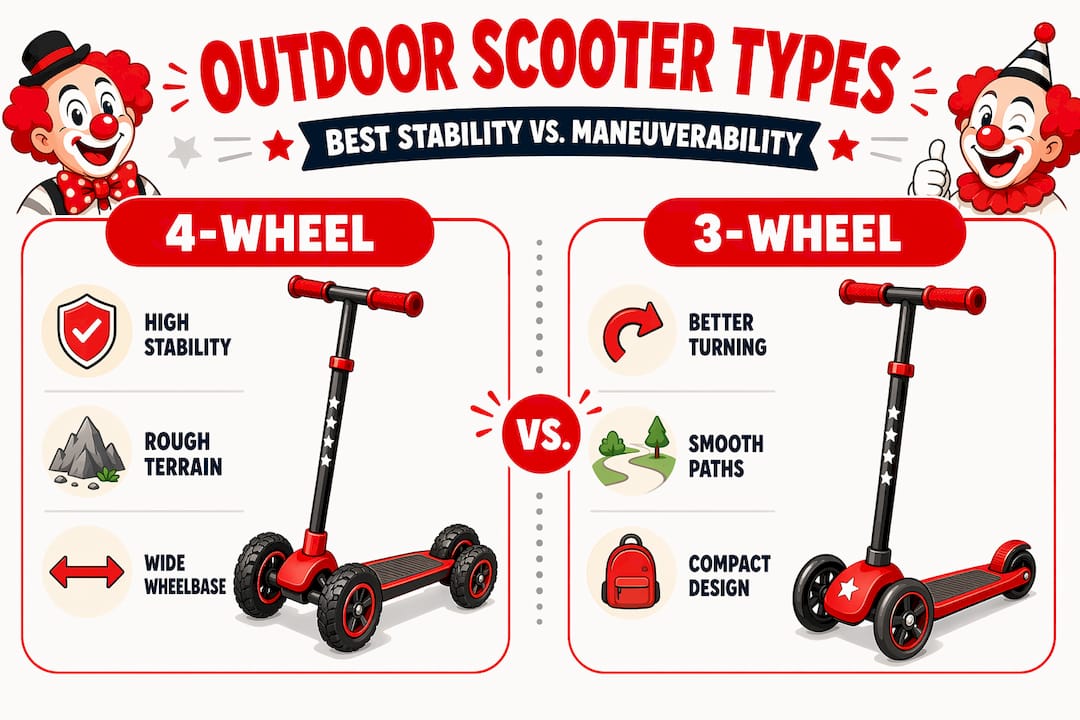
The number of wheels your scooter has is not a minor detail. It shapes how the scooter behaves on slopes, turns, and uneven ground. Four-wheel scooters provide high stability on rough terrain, while three-wheel scooters excel in maneuverability through tight spaces. Knowing which one fits your situation is part of any solid outdoor scooter buying guide.
| Feature | 3-wheel scooter | 4-wheel scooter |
|---|---|---|
| Stability on rough terrain | Moderate | High |
| Maneuverability in tight spaces | Excellent | Good |
| Turning radius | Tight | Wider |
| Best use case | Smooth paths, indoor/outdoor mix | Trails, grass, uneven ground |
| Tipping risk | Higher on slopes | Lower |
A wider wheelbase and a lower center of gravity both reduce the risk of tipping. This matters most when you are crossing a crowned road, navigating a curb cut, or riding on a surface that is not perfectly flat. Many riders underestimate how much a narrow 3-wheel scooter shifts under them on a slope until they experience it firsthand.
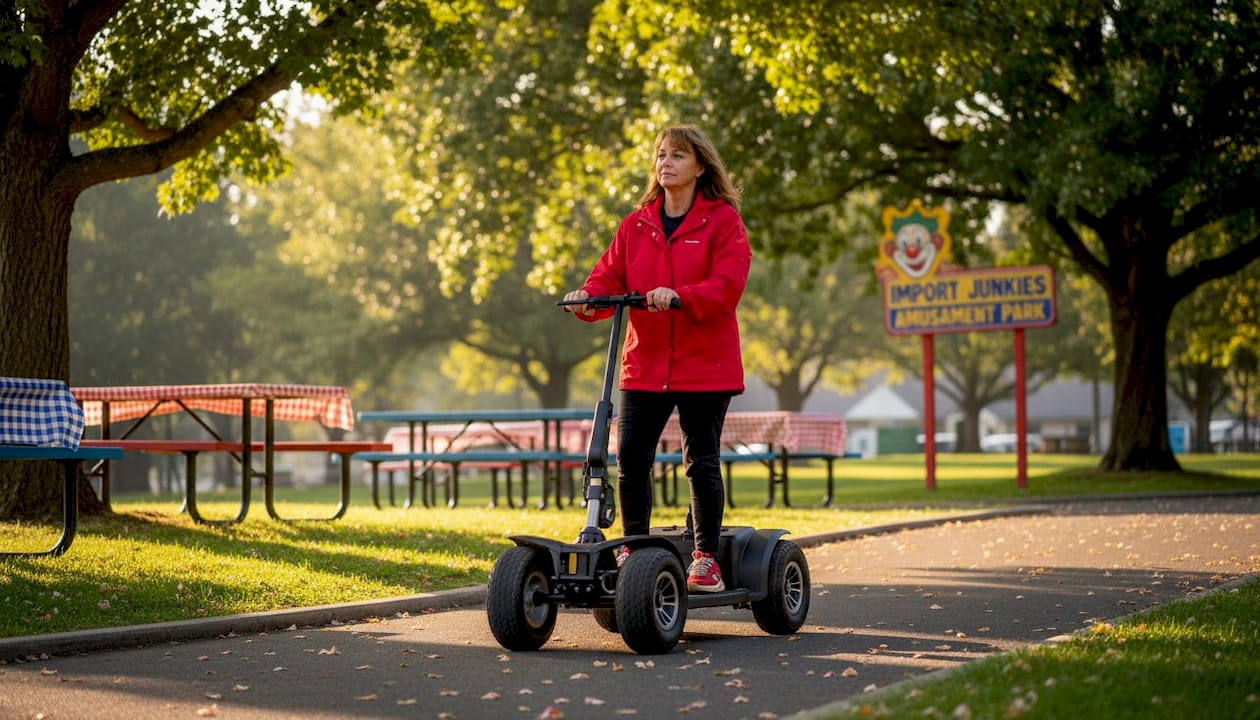
Suspension matters too, but its design varies widely. Some scooters use only front suspension, others use both front and rear. Full suspension absorbs more cumulative impact over a long ride, reducing rider fatigue and improving control. If your rides are longer than 30 minutes or involve rough paths regularly, dual suspension is worth prioritizing.
Pro Tip: If you ride on mixed terrain, including both flat sidewalks and packed trails, a 4-wheel scooter with front suspension gives you the most balanced performance. Reserve 3-wheel models for primarily paved, low-incline routes.
Use this compare scooters step-by-step resource to evaluate specific models against each other before committing.
Battery range, weight, and portability considerations for outdoor scooters
Let’s now discuss how battery life and weight influence your actual riding experience and convenience outdoors.
Battery range is the spec that manufacturers almost always report under ideal conditions. In the real world, hills, rider weight, headwinds, and cold temperatures all reduce performance. Range claims are often 20 to 40% higher than real-world results, and scooters with powerful motors and suspension weigh around 60 pounds. Planning your purchase around the advertised number alone sets you up for disappointment.
Here is what to consider when evaluating battery range and weight:
- Calculate your actual daily distance. Track your typical routes and total them. If your daily outdoor loop is 8 miles, a scooter rated at 12 miles may only give you 7 to 9 miles under real conditions.
- Factor in rider weight. Heavier riders draw more from the battery, especially on inclines. Choose a model rated for at least 20% more than your body weight to preserve motor life and range.
- Weight affects transport, not just range. A 60-pound scooter is manageable on flat ground but becomes a serious obstacle when you need to load it into a vehicle or carry it up stairs.
- Foldable versus non-foldable designs. Foldable scooters are lighter and easier to store but often lack the suspension depth and motor power of non-foldable outdoor models.
- Storage at your destination. If you are visiting a park, trail, or friend’s home, consider whether you can lock and leave the scooter safely or need to transport it back and forth.
Pro Tip: When choosing battery range, target a model that covers at least 1.5 times your typical daily distance. If you usually ride 8 miles, look for a scooter with a realistic range of 12 miles or more. This buffer accounts for terrain, wind, and battery degradation over time.
The 2000W long-range electric scooter at Import Junkies is a strong example of a model built with both power and range in mind for outdoor conditions.
Tires, ground clearance, and suspension: optimizing for rugged outdoor terrain
With battery and weight covered, it is crucial to understand how tires, clearance, and suspension ensure your scooter handles outdoor conditions effectively.
Higher ground clearance prevents scooters from getting stuck on obstacles, and pneumatic tires combined with suspension improve shock absorption and overall comfort. For outdoor riding specifically, these three elements work together as a system. One without the others reduces effectiveness.
Ground clearance refers to the distance between the lowest point of the scooter frame and the ground. For outdoor use, 5 inches or more is the baseline you want. Less than that and you will regularly catch on curbs, roots, gravel mounds, and uneven pavement joints.
Follow these steps to keep your tires and suspension performing at their best:
- Check tire PSI every two weeks. Pneumatic tires lose pressure gradually. Riding on underinflated tires reduces grip, increases rolling resistance, and accelerates wear.
- Inspect tread depth monthly. Worn tread reduces traction on loose or wet surfaces. Replace tires when the tread depth drops below the manufacturer’s minimum.
- Test suspension compression before each ride. Push down on the handlebars and seat. If the compression feels unusually soft or bottoms out quickly, the suspension may need servicing.
- Listen for unusual sounds. Clicking or creaking from the suspension under load often signals worn bushings or loose bolts that should be addressed before they worsen.
- Match PSI to the surface. Slightly lower tire pressure improves grip on loose surfaces like gravel or dirt. Higher pressure is better for paved paths and reduces rolling resistance.
| Tire size | Recommended PSI | Best terrain |
|---|---|---|
| 8-inch pneumatic | 40 to 50 PSI | Paved paths, smooth trails |
| 10-inch pneumatic | 35 to 45 PSI | Mixed terrain, packed gravel |
| 12-inch pneumatic | 30 to 40 PSI | Rough trails, grass, loose surfaces |
| Solid tires (any size) | N/A | Flat pavement only |
For a deeper look at how outdoor scooter specs relate to legal road use and street legal scooter features, that resource covers requirements worth knowing if you plan to ride on public roads.
Common mistakes and expert tips for choosing the right outdoor scooter
Before concluding, let’s look at common pitfalls and practical advice to help you confidently choose the perfect outdoor scooter.
Choosing based only on price or overlooking terrain and battery needs consistently leads to poor outcomes, and real stability depends on design features rather than lightweight construction alone. This is the mistake we see most often, and it is entirely avoidable with the right information.
Here are the most frequent errors buyers make when following an outdoor scooter buying guide without enough context:
- Buying the cheapest available model. Low-cost scooters cut corners on suspension, tire quality, and motor torque. These are precisely the components that matter for outdoor performance.
- Ignoring terrain. A scooter that works well on a flat bike path may be completely unsuitable for a gravel trail or grassy park. Know your surfaces before you shop.
- Prioritizing lightness over stability. This is the most common mistake among first-time buyers. A lighter scooter is easier to carry but harder to control on uneven ground.
- Underestimating daily distance. Many buyers overestimate how far 12 miles feels in practice. Calculate your real routes and build in a buffer.
- Skipping a test ride or detailed spec review. Reading the specifications carefully, particularly motor wattage, tire type, and ground clearance, prevents surprises after purchase.
“For outdoor use, stability should be the first filter you apply, not the last. A scooter that tips on a slight incline or loses traction on loose gravel is not a minor inconvenience. It is a safety issue.”
Pro Tip: If you have a mobility condition or balance concern, consulting a healthcare professional before selecting a scooter is a smart step. They can advise on weight limits, seat height, and stability features suited to your specific needs.
Reviewing the scooter types for outdoor use alongside comparing scooters effectively gives you a structured way to apply these lessons to specific models.
Why prioritizing stability over portability transforms your outdoor scooter experience
Most buyers walk into the decision thinking a lighter scooter is automatically the better outdoor scooter. It feels logical. Less weight means easier handling, easier storage, and simpler transport. But that logic breaks down the moment you take a lightweight model off flat pavement.
The riders who come back most satisfied with their purchase are almost always the ones who prioritized stability first. Not because they ignored portability, but because they understood that a scooter you can carry easily but cannot control confidently is not useful outdoors.
Stability comes from wheel configuration, a wider wheelbase, and a low center of gravity, not from the overall weight of the machine. A well-engineered 4-wheel scooter with a wide stance can feel planted and predictable even on a grass slope or a gravel path, while a lighter narrow-framed scooter may feel unstable on those same surfaces despite being easier to lift.
“Riders consistently report that confidence in their scooter directly affects how far they ride and how often they use it. A scooter that feels secure on varied terrain gets ridden. One that feels unpredictable gets parked.”
The long-term value argument is also worth considering. A stable, well-built scooter that you actually trust outdoors gets used regularly. A portable model that limits where you can safely ride it ends up as money sitting in the garage. When you look at it that way, prioritizing stability is not just a safety choice. It is a practical one.
For families with children, this principle applies to top outdoor scooters for children as well. Stability and control matter even more when younger riders are involved, and the same rules around wheel configuration and ground clearance apply directly.
Explore top-quality mobility scooters for outdoor adventures
Now that you understand what makes a good outdoor scooter, the next step is finding a model that matches your terrain, your distance needs, and your lifestyle.

At Import Junkies, we carry a range of scooters built for real outdoor performance. The 2000W double seat long-range scooter combines a powerful motor with a 60V lithium-ion battery for extended rides, and the 48V adult mobility trike scooter offers stable 3-wheel handling suited to riders who want a balance of maneuverability and support. Browse our full mobility scooter collection to compare specifications, pricing, and models side by side. If you have questions about which model fits your needs, our team is available to help you make the right call before you buy.
Frequently asked questions
What is the main difference between 3-wheel and 4-wheel outdoor scooters?
Four-wheel scooters provide greater stability on rough terrain, while 3-wheel models offer superior maneuverability for navigating tight spaces and turning on flat surfaces.
How far can an outdoor scooter typically travel on a single battery charge?
Most outdoor scooters travel between 10 and 25 miles per charge, with lighter models commonly reaching around 12 miles under typical riding conditions.
Why is ground clearance important in an outdoor scooter?
Higher ground clearance allows the scooter to navigate bumps, curbs, and uneven surfaces without getting stuck or tipping, which directly improves safety and ride comfort outdoors.
Are heavier scooters better for outdoor use?
Heavier scooters generally offer better suspension and stability for varied terrain, but the right balance depends on your specific routes, how often you need to transport the scooter, and your storage situation.
Recommended
- Scooter types guide: Choose the right model in 2026 – Saferwholesale || Import Junkies || Great Sports
- How to compare scooters: a step-by-step guide to smart choices – Saferwholesale || Import Junkies || Great Sports
- How to buy electric scooters: 5 steps to avoid mistakes – Saferwholesale || Import Junkies || Great Sports
- Street legal scooters explained: Requirements, types, and tips – Saferwholesale || Import Junkies || Great Sports


